Showing posts with label RTTT. Show all posts

Wednesday, July 11, 2012

What Every Teacher Should "See" in the CCSS

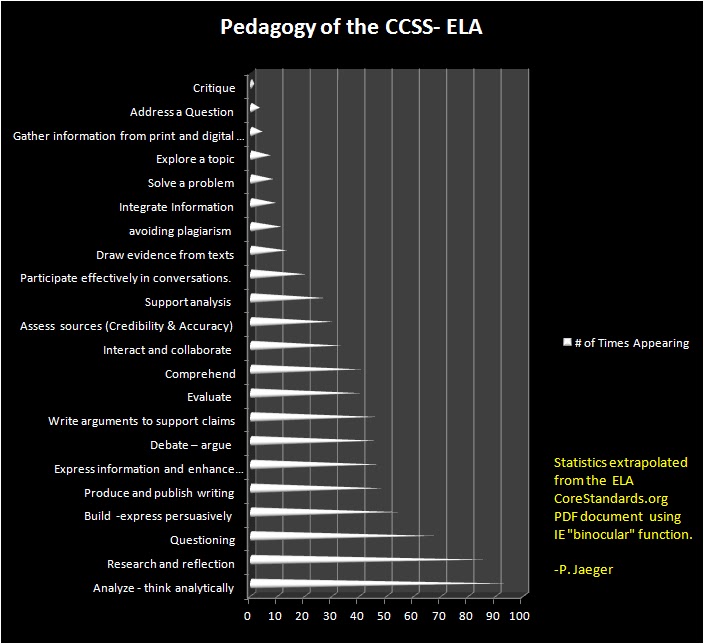
After close examination of the Common Core Standards for ELA, I cannot help but notice that research plays a quantifiable role in how the crafters expected teachers to deliver their content.  We educators hear a tremendous amount about "drawing evidence from the text" and "close reading,"  but why are we not hearing as much about "research both short and sustained projects?"   Why are we not ringing the "conduct short and sustained research projects" ourselves?  

Perhaps teachers are so busy examining the trees that they haven't viewed the forest.  The big picture says: "Insure you have packaged your content in a captivating, 21st Century technology-infused, information integrated, essential question-driven, CCSS package.  

Visit your librarian today and plan a unit for tomorrow.  What question can you ask, that compels students to:
    • examine
    • ask questions
    • research
    • read
    • conclude
    • cite evidence
    • solve a problem, and
    • present their knowledge  


These statistics were quantified using the IE "binocular search" tool with the ELA standards.  
Import the statistics into Excel and graph. 
 [http://www.corestandards.org/assets/CCSSI_ELA%20Standards.pdf]
For those unfamiliar with this tool, here's a snippet:


Wednesday, January 4, 2012

RTTT or RTTB?

Wow  Listen to Seth Godin challenge everyone to examine whether we are racing to the top or racing to the bottom.  As I listened to this award-winning idea guru, I couldn't help thinking that educators were like this.  Either we are racing to the top, teaching via an innovative, technology-rich, Bloom's higher level thought method--or we are racing to the bottom teaching to the test. 
CCSS are asking us to foster creativity and inspire lifelong learning in our students.  What a great idea to transfer to our classroom:  Encourage students to be risk-takers, innovators, believe in a great idea and create.  

I did not agree  with everything Seth Godin  espoused-- if everyone walked to his own drummer we'd have a nation of occupiers and an atmosphere of entropy.  But, we could also promote a little innovation in the classroom and life.     Forget RTTB and trying to just be "efficient" -- Incubate a novel idea today with your students! 

Link here for the video.  (It was here but made the page load slowly, so this was removed.)

Wednesday, September 21, 2011

Common Core Complex Text - Become the Go-to Source

When I was young growing up in "shopping land," Long Island, NY there was a store called Fortunoff's.  Their motto was "The Source."   That's what we librarians are-- The Source. 
This morning, as I fielded a 911 email from a librarian looking for resources, I thought it was important to share this with the greater Cybrary community.  As librarians help teachers find appropriately Lexiled sources for students to read, there is no need to panic.  The following simple steps will help teachers and cybrarians across America meet CCSS requirements for complex text: 
• Databases can be searched by Lexile counts to grab correctly Lexiled passages for any grade level.
• Here is a link to a flyer that explains the importance, if you haven't heard.
• The correct Lexile ranges are found in Appendix A of the CCSS.

• The quickest and easiest source is by the NOVEL NY databases. See the following link for EBSCO's Searchasaurus  as an example.  This has a juvenile interface, but is super easy to use, and --includes higher level resources as well as lower level.   In NYS this is part of our state-wide provided NOVEL resources and is available for ALL NY schools.   Contact your librarian for access information.  Other products such as GALE Academic Onefile and many other GALE products, also have the ability to search by Lexiles.  


A simple search on immigration yielded these results:
I'd like a Staples "Easy button" for this moment.  The teachers love you, and really...it's no big deal.  This is what we do.  We are trained to quickly provide resources, know just where to look and know how to provide them.  Here's a GALE example and please notice the Lexile counts listed.  This is an example of a higher level resource:  

Check the advanced search, if you have trouble finding this Lexile search ability.

THAT IS THE QUICK WAY. There are other ways to search also. Your teachers can find primary source passages at the LOC, on ABC Clio databases, etc,. and then copy the text and paste it into Microsoft Word. At that point, they will need to analyze the text via: Grammar, spelling and grammar, turn on “readability statistics” see picture below. You will get a Fleish-Kincaid level, which roughly equates to Lexile.
See the chart on my website.  On this webpage , I have additional online sites to search for primary source documents, and have other downloadable conversion charts.  The Lexile.com site also has a Lexile analyzer, but it too, has a learning curve to learn. The easiest way to start is with the databases shown above.

We give half day workshops in this for educators and librarians. Almost everyone leaves feeling they are more equipped to handle the Common Core  Complex text issue.  You may want to consider “Lexile-ing” your collection. We did this for ALL of our 84 libraries circulating on our automation system.  Librarians can search by Lexile on any topic. The teachers could also do this and pull a passage from a book.  Some book-jobbers will Lexile your collection for free if you order from them, others charge.  Be certain to inquire what their match rate is for titles.  We were able to obtain about an 80% match for fiction.  Secondary collections come in at about a 50% match, while elementary collections match at the 80% rate.  Some automation suppliers charge big bucks and do not have such success.  Be careful.   

For those who are unaware of what a Lexile is... well you better read the explanation at Lexile.com and become friends with their tools.   RTTT assessments are to built upon Lexile passages.  Make certain your school has aligned their ELA novels with correct Lexile ranges.  That's a no-brainer.  However, many teachers will be disheartened to learn that their sacred cow books are not in the correct Lexile range.  Provide them with some exemplary alternatives!  Become the go-to source.  


Wednesday, August 10, 2011

Engage NY - Don't Be an Educational Ostrich

NYS Education Department has launched a teacher's resource center that is a must-see.   engageny.org  is intended to help teachers in all disciplines meet the requirements of the Common Core Learning Standards.  There are wonderful links that actually spell out the instructional paradigm shifts, provide curriculum exemplars, links to videos for understanding and more.  Please take the time to wander through this virtual self-help site.   
One example of a resource to wrap your head around is the explanation of the Instructional Shifts of the Common Core.   This PDFprovides an overview of the rigor that has been embedded into the standards and changes expected.   To ignore the CCSS focus on change, is to be an educational ostrich. 
The language keeps returning to showing evidence, embedding complex text, and making students accountable for their claims.   Here are two examples from page 4 of the Instructional Shifts:
  • Students have rich and rigorous conversations which are dependent on a common text. Teachers insist that classroom experiences stay deeply connected to the text on the page and that students develop habits for making evidentiary arguments both in conversation, as well as in writing to assess comprehension of a text.
  • Writing needs to emphasize use of evidence to inform or make an argument rather than the personal narrative and other forms of decontextualized prompts. While the narrative still has an important role, students develop skills through written arguments that respond to the ideas, events, facts, and arguments presented in the texts they read.
If you are worried about what the APPR will look like, check out these new guidelines.   Pictured below are two slides from the evaluation timeline.   This concurs with the advice we have given to start your archive of teaching effectiveness from day one this year.   Start building your instructional  portfolio and try to embed assessment for learning along the way.  Innovative assessment--not tests, per say;  Performance based assessment that is tracked;  EQ's that reflect student learning;   Be aware of what is required.  


Tuesday, August 9, 2011

RTTT, CCSS, the Library & Classroom Resources

Many librarians find it disheartening to hear literacy programs such as Fontas & Pinnel mandate the existence of a classroom library to enrich the student's choices.  Do we really need to replicate the library in every classroom?   If a standard elementary school has 6 grades, and let's say 4 classes in each grade, we have 24 classrooms each with 500 books, yielding a total of 12000 books in the school--which are not lexiled, indexed, cataloged for easy access, and more.  The students are merely able to easily grab a book when they want. They might have been chosen by educators well acquainted with good literature and the premise might be all well and good--but they now come with a long list of new caveats.  
      Along comes the Common Core with reading rigor now required.  These classroom libraries are not apt to meet the Common Core mandates for reading with targeted complex text.  While these classroom libraries might be convenient, we should turn our attention to the reading requirements of the CCSS.  The framework for the PARCC assessments has just been released. Here are some interesting statements:
* "To succeed on the PARCC assessments, students need access to a wide range of materials on a variety of topics and genres...to ensure that they have opportunities to independently read widely among texts of their own choosing during and outside of the school day.... Such independent reading needs to include texts at the reading level of students as well as texts with complexity levels that will challenge and motivate them." (p.6)
* "Leveled texts that are below grade band level in complexity are not a substitute; the standards indicate students should be reading grade band-level complex text.  ( from: Draft Model content Frameworks for ELA/Literacy PARCC p.6)
* Writing expectations: "Present credible evidence from texts,..." (p.8) "practice of students learning how to read closely...."
So under carefully planning, teachers need to be cognizant of not only good books, but the content, lexiles, text complexity and more.  Librarians can help classroom teachers with this difficult task.   Most book-jobbers and third party automation hosting solutions offer a recon for catalogs which will embed Lexile counts on all library books. (Mackin, Perma-bound and Follett are three.  Compare the fees as they are vastly different.)  We just finished Lexiling all our our 84 school library catalogs with Lexile counts.  These 84 school librarians will be able to assist classroom teachers with identifying correctly matched reading material for students and classroom materials.   I ask: are those 500 book classroom F & P collections matched to challenge the readers with the recommended Lexiles for each grade? 
      At the site www.Lexile.com  librarians and teachers can quickly assess the level of a book, title by title.  This site by Metametrics, also offers many explanations as to why complex text is important and the role that Lexile plays in assessment and instruction. 
Happy reading, and remember.... ask your school librarian to assist you in finding great books to match reading interests., ability, and instructional mandated levels. 

Thursday, August 4, 2011

APPR, Assessment & RTTT - Ready or not!

As part of the RTTT requirements, states must find a way to evaluate all certified teachers  (and principals) for efficacy.  NYSED just announced the "approved" assessment tools for the 40% local assessment.  We know that part of the 40% will be comprised of formal state assessments for "tested" areas, but for many certified teachers in non-assessed areas, this 40% becomes locally defined.   NYSED just announced the list of approved 40% tools
for local use:   http://usny.nysed.gov/rttt/teachers-leaders/assessments/home.html   On the page, please note on part "2. Locally-selected measures of student learning"-- "If a district or BOCES decides to use a district-wide goal-setting process as part of the locally-selected subcomponent, a district or BOCES may use an assessment on the List of Assessments; a State assessment; or a school or teacher-created assessment, provided that the district or BOCES verifies that the goal-setting process is rigorous and comparable across classrooms."

This could very well be what we all see as this is not apt to cost each district money.  Most of the options on the approved list of assessment providers cost considerably.  This might be the time to start thinking about goal setting.  To review a principal of goal-setting: 
 SMART goals = Specific, measurable, attainable, relevant, and timely.
  What does this mean?  Ask yourself the following questions:
  • What can I do that will enhance student achievement and meet building goals?
  • How can I measure this (2 points of time...specifically defined)
  • Are these attainable? Can I reach these students? Are these EQ's on my curriculum maps?
  • Is this relevant to the common core (remember, Dewey is no where in the Common Core, but finding information is.  Synthesizing information is.  Fostering information literacy and technology skills is.  Increasing a students ability to evaluate information for credibility is....and more. 
  • Can I assess this between two points of time - probably September and June 
You will also want to start day 1 this year building a portfolio of teaching efficacy.  Start by preparing simple folders with the seven areas of NYS teaching standards labeled:
  1. Knowledge of Students & Student Learning
  2. Knowledge of Content & instructional planning
  3. Instruction - teaching for learning
  4. Learning Environment
  5. Assessing Student Learning
  6. Collaboration & professional responsibilities
  7. Professional Growth 
These folders will help you archive evidence of student achievement, teaching effectiveness, and provide artifacts for evaluation.   Here are some thoughts to help you figure out what to concentrate on:  What are your building achievement goals and how can you support them?  Can I help certain grade levels achieve better by collaborating?  Are there data analysis reports that you can review to determine whether you can influence student achievement withing your library time?   Are your curriculum topics closely aligned to the curriculum that is tested?  Can I help teachers with inference? Can I begin a boys book club (if stats show that your male readers are falling behind)? Can I communicate with caregivers to insure that they are aware of our resources that are available 24-7 from home?  This list could go on and on.... 


You may want to increase your knowledge of authentic assessment and how to capture assessment to demonstrate student growth.  Traditional focus has kept a focus on "measuring" summatively, student knowledge -- recall.  Truly effective assessment will measure at the beginning (diagnostically) to inform instruction.  We can measure along-the-way, also (as knowledge is forming) to monitor and adjust our instruction.  Or, students can self-assess and re-direct (also formative).  The current shift in summative assessment is to create rubrics for knowledge products that concretely demonstrate that your students have created new knowledge via synthesis of information, ideas, technology, tools, and skills. 


Between the locally chosen methods of assessment, goal-setting and achievement, and portfolios that you may be required to create,  you will be evaluated.  Why not give it your best shot to be a "highly effective" educator?  This is our time to shine.  We  librarians and cybrarians are well-acquainted with Inquiry, Collaboration, and supporting the learning goals of the buildings in which we work.  Never fear... with thought, planning, and determination, we can support the Common Core and our buildings' achievement.