Showing posts with label independent reading. Show all posts

Wednesday, January 8, 2014

Building Bridges: Collection to Classroom

Am I the only one who is disturbed to read national postings such as this? 

A small  classroom library serves a purpose of convenience and ease, but cannot match the quality and quantity and recommendations from a well-supported, well-maintained school library.  This just keeps kids in the classroom-silo that much more. 
  • Don’t we want them to experience more than a garage sale special collection sitting on a shelf in a classroom?   
  • Don’t we want them to move beyond their “J” of “E”  straight-jacket reading?  
  • Don’t we want them to enlarge their world beyond the teacher’s choice?
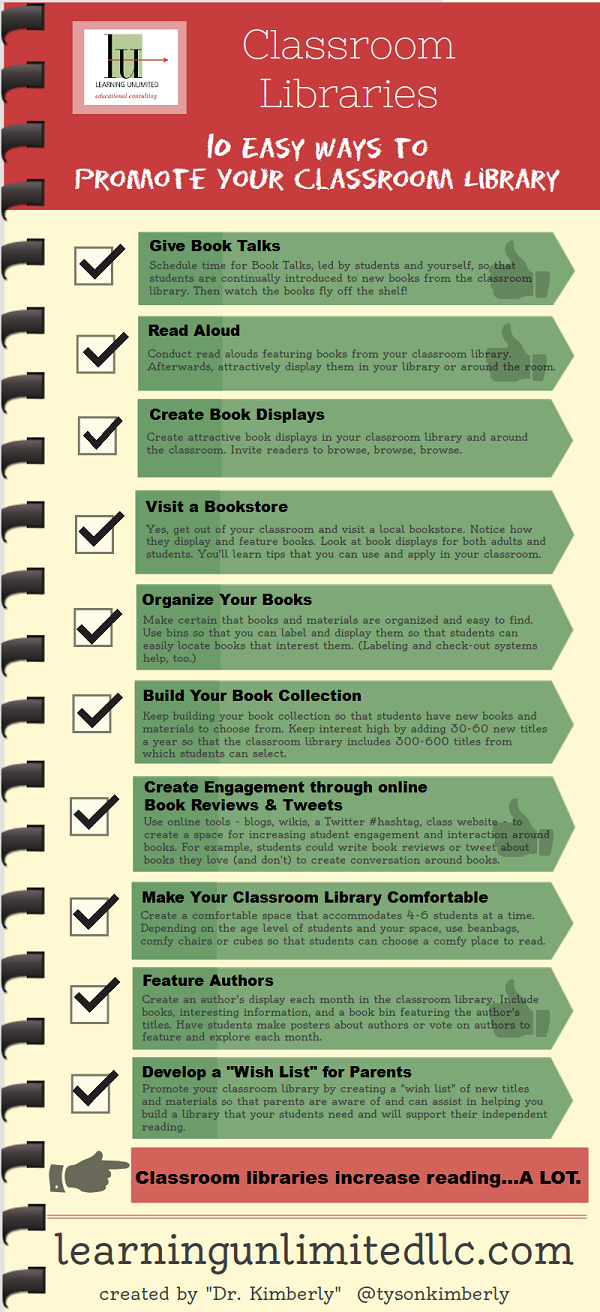

We have notables such as Kelly Gallagher speaking all around the nation espousing the need to build robust classroom libraries which most often duplicate resources found on the shelves in libraries.  When he spoke here and we confronted him on statements, he did recant and say that classrsoom shelves cannot replace a great library.  When I read this infographic posted above, about classroom libraries, it brought Gallagher’s conversation back to mind. (I love Gallagher's books, but recommend collaboration with the librarian.) 

While I commend Jeff @edudemic for wanting to foster a wonderful reading environment, I caution him against circumventing the robust collection of his building library and the expertise that the librarian has in building, maintaining and circulating their collection. 

Building Bridges: 
Chris Harris, a colleague,  suggested once to circulate the library collection to the classrooms, and that would be a better avant-garde solution to this model.  At least the library would be involved in the process. 

So, if your teachers are in this “classroom library” mode as espoused in many books, here are 7 ideas to keep you in the loop: 

  1. Rotate some of your captivating nonfiction, -good fictions that are sleeping, and other titles to fill this need.  
  2. Deliver them with "stars" on the cover and market them as 5-star books!   
  3. Slip bookmarks in the books which suggest they log into the library catalog and create a book recommendation when they're done.
  4. Offer to do the booktalks for the teacher. 
  5. Suggest a technology integration for book trailers when they're done. 
  6. Give the teacher pre-printed library passes for reluctant readers.  When you see that "hot colored" pass, you know it's a clue the student needs extra help.  
 Don’t worry about the losses.  Get those kids reading.   Add value to the classroom process.  Build those classroom bridges and maybe the next time they will come to you for information and collaboration.  When they see you have more to offer, they’ll seek you out….possibly. 

Friday, February 22, 2013

6 Reading Rules for the Common Core


Once again, yesterday, I defended a librarian espousing that their student should be able to checkout whatever they wanted to read for independent reading.    Where do teachers get the idea that kids should read, an "M" or a 6.5?   Have you ever heard a student say, "I really want to read a "P" book at home."  No.  They say, "I really want to read a muscle-car book."   Or, they may say..."I really want to read that book about ..."  and most of the time the librarian can read their mind and share the title. 

As people wrap their heads around the Common Core and get more familiar with content and process, it's important to understand the key precepts of independent reading.  We have Stephen Krashen and Marilyn Adams to thank for a great deal of the reading research which lends a playbook for your everyday librarian:  


  1. The more students read, the better they'll read*   So, why limit their reading to a pre-set reading level with limited titles available? 
  2. Students need opportunities to read easy books to build fluency  - This is ratified in Appendix A, Page 9,  of the CCSS standards.  We shouldn't have to define what level they should read at -- whether easy or hard -- for independent reading. 
  3. Students need experience reading complex text to improve their ability to decode meaning when they encounter difficult material - This is based on the research of Marilyn Jager Adams, PhD. Brown University
  4. Students will  shift from easy -->  hard  material if it's on a subject of their interest.  - So let them choose what they want and their innate curiosity will compel them to read and achieve understanding, thus raising their reading ability. 
  5. Students need curiosity to inspire reading.  They will either have natural curiosity or stirred up curiosity (stirred up by the educator) 
  6. Students need a reason to read that is not about 'assignment' - a quest for knowledge or an answer to find.    

* [Source: - Technically, I should cite this source, as I contributed to this article for Expeditionary Learning, and used the same wording in this article which was published under their name: http://www.engageny.org/sites/default/files/resource/attachments/volumeofreading.pdf]