Showing posts with label plagiarism. Show all posts

Monday, October 7, 2013

Voki - Avatars - Crazytalk and Other Pseudo Friends

This hyper-connected generation loves technology, but unfortunately, it is not a panacea for high performance. It is a tool for engagement, or to entice students to have fortitude to complete the assignment.    Opportunities to embed technology are endless, but with the CCSS technology should take a back seat to higher level thought.  

(See this previous post for an example of Teddy Roosevelt CrazyTalk speaking to America...This was crafted during the first Obama run for presidency, after a student had done his research.) 

Teaching should not be about the technology.  It should be about the synthesis of information and reporting those conclusions via a 21st Century tool.    Technology will also help you engage the learner to "hear" a message that would be tuned-out via verbiage, text or talk.   Here's one of those for example.... It's that time of year I resurrect my Voki witch, ala Wicked Witch of the West, to remind students to not copy and paste:  https://tinyurl.com/y58wwa5t 


Listed below are some sample essential questions that could be used for research reports that are Common Core aligned, using Vokis, Xtranormal, Crazytalk, or other avatar generator tools.   For each question, notice the synthesis of "facts" required to answer the question.  If your teachers are crafting research to "fetch facts"  and not do anything with those facts, they are not Common Core aligned.   Higher level thought is developed by requiring kids to think, conclude and create something with their "facts."  


CURRICULUM CONTENT
EQ
Explorers
How did geography impact your exploration?
Colonists
What would your colonist say to America today?
Presidents  - US or other national leaders
What was the lasting legacy of your presidency and why?  Have we treasured or trashed this today?
Mathematicians
How did your mathematical discovery impact our life today?
Scientists
How did your discovery improve our life, products, or future?  Why should we be grateful for your hard work?
Inventors
Convince me, your peer,  to fund your invention.  How will it improve my life? 
Planets
Why does the sun deserve the golden globe award?  What should be the official number of planets in our solar system?
 
If your teachers are not researching, perhaps they need an invitation from you.   Create an avatar model and suggest an alternative to a previous typically low-budget thought research paper that comes through your door.    

Students should be building an evidence-based claim.  Each one of the above affords the students to dig up facts to support a "claim."  Notice how for each of these projects, technology is not embedded until the end--after a student has done the digging and synthesizing.   This becomes the "knowledge product."    Why you could even do these witches for your own library curriculum asking, "How is information organized?"    

And, if your school doesn't have the technology to create these Avatars, or your technology doesn't support Flash yielding it unable to do this...create an alternative.  Perhaps a video, speech, or simple audio recording on a www.thinglink.com  would do the same!

Tuesday, October 16, 2012

Why Students Plagiarize...


It makes total sense  that students are cheating, when they have no motivation to learn the content.  If students don't care about what the assignment is, then why would they care about how they obtained the content in their assignment?    On the other hand, if we craft assignment with compelling content, which makes students think, investigate, and  synthesize-- they will want to draw original conclusions which are then supported from the text--drawn from evidence in the text--taken from what they have 'read closely,' and supported by concurrent conclusions they found in their research to support their point of view, opinion, and conclusion.  That my friend, is a mini summary of the Common Core ELA standards. 

Watch this new video posted from Tara Barbazone at the University of Bolton, UK.  This professor, teaching "Scholarship" investigated to understand and helped uncover and discover the roots of plagiarism: The lack of creativity, original thought, and more.  The kids admit it.  Until we motivate the students to think on their own, will they claim the thought of someone else, and plagiarize, because they are ashamed that they can't think themselves.   And, we thought they were just dishonest or lazy.  Shame on us. 

A properly prepared unit should by nature avoid plagiarism.  However, teacher themselves need instruction on how to repackage their units for higher level thought and student originality.  Heaven help us all.


http://www.youtube.com/watch?v=twnmZ2tLgUo

Wednesday, June 13, 2012

The Scarlet P ?

Try this  Plagiarism Arthur episode -- This is a short  winner. Not only does this short two minute cartoon support CCS  Writing 8 but it has the the CCS vocabulary shift in mind.  Francis commits "the most egregious crime...." Or,  It's disturbing that "our dear friend will languish in yonder cage, while we stuff." 


As I watched this, I thought his was almost better for secondary students than it is for the 4 year old crowd.   Humor is wasted on the young....


Thanks to Salem Central Librarian, Karen Fronhofer who still has young kids, for this suggestion!

Monday, March 26, 2012

Old site-new discovery: Internet Detective

With over a webpages now archived in search engines, it is always possible that there are gems to discover that are sitting among the files waiting to be discovered.   We know that the United Kingdom is across the ocean, but in our flat world, it's just a click away.   While preparing for a Google Alternatives PD session tomorrow, I stumbled across this little Internet Tutorial tool that is too good not to mention!   This is a tool worth mining into your Live Binders or other aggregating tools. 

It's hard to believe that this was created by the higher-education community as I see it as a good tool for secondary instruction.  However, that's the state-of-our-information-illiterate-union.   Every cybrarian or tech teacher should add this little tool to their cadre of secret weapons for web instruction. 
 
Thank you to the University of Bristol: http://www.vtstutorials.ac.uk/detective/index.html


While we're at it, try out this little Citebite.com  tool that will help students avoid plagiarism: 

Friday, February 24, 2012

Class Action Espionage? - Another tool for the plagiarism toolbox

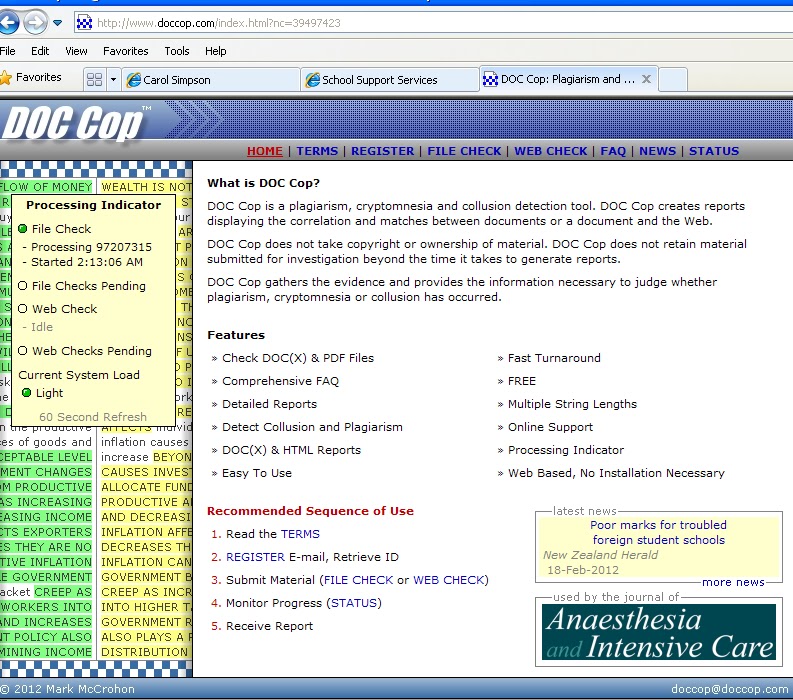
If you are looking to save a little money in your budget next year, try http://www.doccop.com/ as an alternative to the forensic Turnitin. This free tool does not have all the bells and whistles that Turnitin.com has, but serves as an instructional tool for students to self-assess their work. Why not "teach them to fish" for plagiarism, rather than policing it yourself? You could even package this as verbiage stalking or research surveillance and the students might drink the coolade. It might even be fun to have the students peer review for plagiarism and and award papers an affidavit of authenticity.   This is not to substitute for a lesson on giving credit where credit is due, but is just another tool for your toolbox. 

Years ago, I remember reading a report written by 8th grade Eddie. It was a beautiful biographical synopsis of his favorite guitar player... So beautiful, that we knew Eddie did not compose it. Now Eddie might have been able to play the guitar beautifully, but he could not write a report. A simple check provided us the source of his narrative wonder. Eddie did not understand plagiarism. In fact, Eddie did not understand writing.

Carol Simpson, one of the leading voices on digital ethics, recommends this tool as well as Turnitin.

What this product does is:
* allows a submission of about 500 words to be checked.
* breaks up the submission into 500 successive "strings" of words
* Searches the web for each of the 500 strings
I tested DocCop with some original work and found that not one string was plagiarized. Then, I copied some wording from an article I wrote that is out on the web, and it found a few instances of phrases quoted from the article along with similarly worded phrases that were close to "common knowledge." So, it does find the match.

This tool may not search the "deep web" but rather uses Bing to search the surface web. This does not compare to the archived data within Turnitin, which is likely to have sources quoted from numerous databases, but at least it's a start. Whether you are librarian or a classroom teacher, the CCSS say we should be teaching students to research and write, "while avoiding plagiarism."  [CCSS, ELA Anchor Standard 8] At least we can search through the garbology of the web.  


Carol Simpson puts it nicely when she shares this quote in a PPT: "We are living in a world of nuclear giants and ethical infants." This might be an uphill battle, but it's a battle worth the scrimmage. After all, these students are tomorrow's society and there's no shortcut to success.