The plethora of educational acronyms now includes a new one: TMI--too much information. We are no longer living in the Information Age, but are now living in the age of misinformation. My son remarked, "did you know that 80% of statistics are made up on the spot?" And I replied..."Like that one?"
I believe the impetus behind the Common Core focus on information, problem solving, and writing from the text, comes from the need to separate belief, hearsay, and opinion from truth, fact, and foundational knowledge. Not only to students need to know how to speak and write with authority, but they need to be able to place credence behind their claims.
This generation has grown up watching detective shows, Judge Judy, reading crime novels (check out the Grisham YA book on featuring kid lawyer Theodore Boone) and crime scene serials that have disgusting content far beyond imagination. As a result, students may have trouble discerning truth from error. They have Too Much misinformation in their brains.
David Coleman says, "CCSS calls for rigor," and rigor is not Google.
In her book, Web of Deception, Anne Mintz likens our students to Internet Nomads wandering aimlessly or naively, on the Internet only to find misinformation. [http://books.google.com/books/about/Web_of_deception.html?id=uS3p9iDooc8C]
Anne goes on to paint a picture of a world of misinformation from Journalism to Education. This book alone should justify the need for librarians and information literacy instruction. The Misinformation Age is documented in this book, with "content farms" being exposed as credible spammers spawned to make money. This book is freely readable on GoogleBooks.
Common Core Takeaway:
More importantly, I firmly believe that the crafters of the CCSS, knew that this MISINFORMATON AGE is the environment in which the next generation will have to function. Perhaps that is why they need to cite their source, speak with conviction, draw evidence form the text, persuade with statistics and write reliable, credible, papers that are backed up with facts. We are living in a data-driven society and they will need to learn how to do more than "tweet" and update their status. Let's prepare them!
Showing posts with label complex text. Show all posts
Friday, May 18, 2012
Information Overload: TMI
Labels: library, librarian, 21st Century Learning,
CCSS,
complex text,
library research
Thursday, May 17, 2012
Thus Saith the Common Core about Graphic Text
I chuckle when, via a feed, I receive something talking about a rubric for "graphic text" and wonder how librarians could be so far ahead of the pack? We're discussing transliteracy, graphic text, infographics, comic life, multi-literacies and more...when the CCSS are giving us rubrics to determine what "text" we should use in our instructional delivery, they don't address this.
We librarians have realized that communication had moved beyond alpha-numeric delivery to information products which convey inference, require extrapolation, and visual messages that require deep content knowledge to uncover and discover messages. However, our CCSS authors want us to insure that we have a literate generation who can write when they need to....And, yes, that is of utmost importance.
To understand the rational behind the definition of classroom text to be alpha-characters, you'll need to read Appendix A, page 4 paragraph 2. "text-free or text-light sources, such as video, podcasts, and tweets. These sources, while not without value, cannot capture the nuance, subtlety, depth, or breadth of ideas developed through complex text."
Let's compare and contrast:
Rich Text: Lexile 9-10th grade band
We librarians have realized that communication had moved beyond alpha-numeric delivery to information products which convey inference, require extrapolation, and visual messages that require deep content knowledge to uncover and discover messages. However, our CCSS authors want us to insure that we have a literate generation who can write when they need to....And, yes, that is of utmost importance.
To understand the rational behind the definition of classroom text to be alpha-characters, you'll need to read Appendix A, page 4 paragraph 2. "text-free or text-light sources, such as video, podcasts, and tweets. These sources, while not without value, cannot capture the nuance, subtlety, depth, or breadth of ideas developed through complex text."
Let's compare and contrast:
Rich Text: Lexile 9-10th grade band
Susan B. Anthony: “Friends and fellow citizens: I stand before you tonight under indictment for the alleged crime of having voted at the last presidential election, without having a lawful right to vote. It shall be my work this evening to prove to you that in thus voting, I not only committed no crime, but, instead, simply exercised my citizen's rights, guaranteed to me and all United States citizens by the National Constitution, beyond the power of any state to deny....”
Cheap Text: Ellen DeGeneres Commencement Speech, Tulane 2009:
Thank you, President Cowan, Mrs. President Cowen; distinguished guests, undistinguished guests - you know who you are, honored faculty and creepy Spanish teacher. And thank you to all the graduating class of 2009, I realize most of you are hungover and have splitting headaches and haven't slept since Fat Tuesday, but you can't graduate 'til I finish, so listen up. When I was asked to make the commencement speech, I immediately said yes. Then I went to look up what commencement meant. … So I had to break the word down myself, to find out the meaning. Commencement: common, and cement. Common cement. You commonly see cement on sidewalks. Sidewalks have cracks, and if you step on a crack, you break your mother's back. So there's that. But I'm honored that you've asked me here to speak at your common cement. I thought that you had to be a famous alumnus - alumini - aluminum - alumis - you had to graduate from this school. And I didn't go to college here, and I don't know if President Cowan knows, I didn't go to any college at all. Any college. And I'm not saying you wasted your time, or money, but look at me, I"m a huge celebrity. Although I did graduate from the school of hard knocks.... [ http://www.hark.com/clips/wfxbjlpnnh-ellen-degeneres-commencement-speech-at-tulane-university]
Graphic Texts:
These graphic texts are actually embraced as "knowledge product" suggestions in the writing standards. Math standards also embrace extrapolation of data,relationships and modeling which could be "stretched" to create infographics which picture relationships, cause and effects, ratios, and more.
The words "graphic texts" do NOT appear in the CCSS at all. There are 98 instances of the words "graph" in them in the math standards, but most of those relate to mathematical functions-- not as vehicle to communicate and share knowledge in diverse formats for diverse audiences.
The very act of summarizing and picturing information, proves the content has been assimilated, digested, reformatted, and probably committed to long-term memory.
So the moral of the story is: Teach with rich Text, graphic text should be used as knowledge products. Thus saith the Common Core.
Labels: library, librarian, 21st Century Learning,
CCSS,
Common Core,
complex text,
graphic text rubric,
Lexile,
library
Tuesday, January 17, 2012
Text Complexity for Dummies
Not that we educators are really dummies, but for those who are clueless on what the Common Core has to say about using "rich text" in the classroom, here is one of the best overviews that I have seen. NYC is a behemoth and therefore uses their resources to efficiently reach a great number of teachers. Once again, they have created a wonderful tool available to the nation. Click here to view.
They speak that the 3 key points in Appendix A for consideration when determining whether a text passage is appropriate for "rich text" classroom usage are:
- Quantitative measures (algorithmic measures of complexity)
- Qualitative measures (more subject to the teacher's appraisal (What is the vocabulary of text? What is the content - does it relate, enhance, build knowledge, etc.) View the rubric in this video at this link. It is one of the better tools I have seen. Some of the considerations evaluated in the rubric are: layout;
purpose and meaning;text structure;language features;knowledge demands
length?
background knowledge required
level of reasoning required & more. - Considerations of the reader and the task - What can you ask the students to do with this data? Can they investigate? Can they debate, dialogue, discuss, react, quote, generate further questions for investigation? Can I couple this passage with any of the "Power Verbs" below?
Whether you are a novice or expert in understanding the theme of rich text, this video and the rubric are worth investigating. See you school librarian for help in finding examples on how to mine for rich text, how to search for great primary sources freely available, or where to look on the web for resource within databases correctly lexiled for your classroom. (See older posts below on Lexiles, Mining for Rich text and more.)
Labels: library, librarian, 21st Century Learning,
CCSS,
complex text,
Rich Text instruction
Friday, December 9, 2011
Fishing for Lexiles?
Fishing is a peaceful, boring, activity--unless you catch one. If you sit there and row your boat all day, you'll be tired, discouraged, your muscles will ache, and all you'll go home to make a PBJ. And for ice fishing?...I once heard someone say they'd rather get a root canal, than sit out in the cold.
Searching for Common Core complex text is similar to that experience for teachers. They don't know how to fish and they are coming up short. Listed below are a few tools to analyze text for Lexile levels. Use these to help find instructional resources for classroom use. In addition, I have a link below where where you can catch some primary sources.
- The Readability Statistics within Microsoft Word
- http://www.lexile.com/fab / Find a book's Lexile score at this link by either the title (upper right hand corner search box) or search for titles that are at the proper Lexile level.
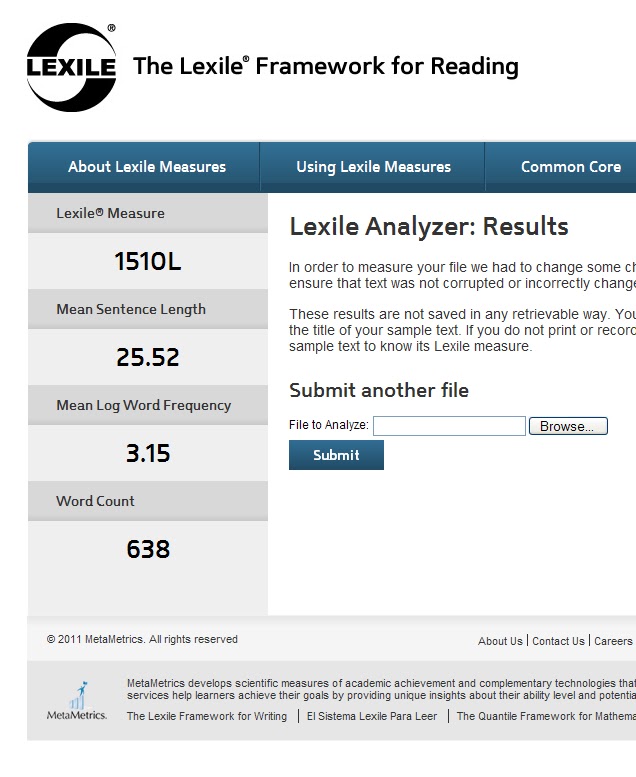
- Lexile Analyzer - http://www.lexile.com/analyzer/ Create an account and upload .txt files such as primary sources - This is the most reliable way to get a true Lexile. All the others are approximate substitutes.
- http://juicystudio.com/services/readability.php#readintro - Will analyze URL’s readability.
- http://www.readability.info/ - another place to upload a URL and get the readability of the URL/site.
In general, the “readability” ratings come in about 100 points lower than Lexiles per thousand. Therefore something with a readability index of about 850, you would likely add about 85 points to get the correlating Lexile. The Lexile.com resources by Metametrics are the most reliable. However, getting a Lexile is only one piece of the puzzle in understanding the Common Core and meeting the requirements to embed rich text with deep meaning. Teachers will want to also consider:
- Does the piece have additional opportunities to enrich learning?
- Does the piece use the vocabulary of the discipline?
- Is the piece engaging for the learner?
- Does the piece lend itself to additional research and learning activities such as debate, research, discussion, etc.
Labels: library, librarian, 21st Century Learning,
CCSS,
complex text,
Lexile
Monday, November 14, 2011
Complex Text and Common Core
When we were young, and reading was difficult, we would remark, "It's all mumbo jumbo to me." However, our generation had no alternative to print. It wasn't like we could substitute video for learning, pictures, infographics, or more. It was do or die...so we had to try. We built determination, focus, and fortitude. All three are lacking in the Millennials, according to the research behind the Common Core.
In the appendix to the Common Core, the research is noted as to why the CCSS authors recommended increasing Lexiles and stressed the need for students to tackle complex text. As I sorted through the research, personally trying to find the "why" behind the increase in Lexiles, I stumbled upon the following poignant golden nugget of truth that are worth sharing:
As educator's hear this for the first time, they are asking, "Wheres the research behind this position?" I'm continuing to dig into the Appendix A reading research to find this, but the body of research presents a clear compelling picture that we've moved a long way from rigor. It's time to return. Rigor is not Google. Rigor is not reading for pleasure. Rigor is compelling content and a question to answer that required students to: dig, research, debate, find meaning, create, reply, construct, continue and collaborate....Inquiry based learning. Ask your librarian for some help in designing a unit for deep learning. Ask your Cybrarian to help you dig up a document from one of many primary source libraries or current databases that have articles filled with your content vocabulary and present problems that need to be solved. Increase rigor and increase relevance.
In the appendix to the Common Core, the research is noted as to why the CCSS authors recommended increasing Lexiles and stressed the need for students to tackle complex text. As I sorted through the research, personally trying to find the "why" behind the increase in Lexiles, I stumbled upon the following poignant golden nugget of truth that are worth sharing:
K–12 Schooling: Declining Complexity of Texts and a Lack of Reading of Complex Texts Independently
Despite steady or growing reading demands from various sources, K–12 reading texts have actually trended downward in difficulty in the last half century. Jeanne Chall and her colleagues (Chall, Conard, & Harris, 1977) found a thirteen year decrease from 1963 to 1975 in the difficulty of grade 1, grade 6, and (especially) grade 11 texts. ...Average sentence length and vocabulary level in reading textbooks for a variety of grades declined. ...Carrying the research closer to the present day, Gary L. Williamson (2006) found a 350L (Lexile) gap between the difficulty of end-of-high school and college texts... What is relevant in these numbers is the general, steady decline—over time, across grades, and substantiated by several sources—in the difficulty and likely also the sophistication of content of the texts students have been asked to read in school since 1962.
Worse still, what little expository reading students are asked to do is too often of the superficial variety that involves skimming and scanning for particular, discrete pieces of information; such reading is unlikely to prepare students for the cognitive demand of true understanding of complex text.
Moreover, current trends suggest that if students cannot read challenging texts with understanding—if they have not developed the skill, concentration, and stamina to read such texts—they will read less in general. In particular, if students cannot read complex expository text ...they will likely turn to text-free or text-light sources, such as video, podcasts, and tweets. These sources, while not without value, cannot capture the nuance, subtlety, depth, or breadth of ideas developed through complex text. [p.4 -- This is the "transliterate" youth of today. As transliterate as they may be, transliteracy won't build lawyers, actuaries, or detail-oriented individuals who have the fortitude to change the world.]
The most important implication of this study was that a pedagogy focused only on “higher-order” or “critical” thinking was insufficient to ensure that students were ready for college and careers: what students could read, in terms of its complexity, was at least as important as what they could do with what they read.The Common Core standards have asked us to raise difficulty of classroom content so that classroom instructional material would be considered, "complex." This fits very well into the Differentiated Instruction model, regardless of the students' abilities. We should be presenting challenging material to our students so that their level of reading skill will increase --regardless of where they are reading now.
As educator's hear this for the first time, they are asking, "Wheres the research behind this position?" I'm continuing to dig into the Appendix A reading research to find this, but the body of research presents a clear compelling picture that we've moved a long way from rigor. It's time to return. Rigor is not Google. Rigor is not reading for pleasure. Rigor is compelling content and a question to answer that required students to: dig, research, debate, find meaning, create, reply, construct, continue and collaborate....Inquiry based learning. Ask your librarian for some help in designing a unit for deep learning. Ask your Cybrarian to help you dig up a document from one of many primary source libraries or current databases that have articles filled with your content vocabulary and present problems that need to be solved. Increase rigor and increase relevance.
Labels: library, librarian, 21st Century Learning,
CCSS,
Comjon Core,
complex text,
library instruction
Wednesday, September 21, 2011
Common Core Complex Text - Become the Go-to Source
When I was young growing up in "shopping land," Long Island, NY there was a store called Fortunoff's. Their motto was "The Source." That's what we librarians are-- The Source.
This morning, as I fielded a 911 email from a librarian looking for resources, I thought it was important to share this with the greater Cybrary community. As librarians help teachers find appropriately Lexiled sources for students to read, there is no need to panic. The following simple steps will help teachers and cybrarians across America meet CCSS requirements for complex text:
• Databases can be searched by Lexile counts to grab correctly Lexiled passages for any grade level.
• Here is a link to a flyer that explains the importance, if you haven't heard.
• The correct Lexile ranges are found in Appendix A of the CCSS.
• The quickest and easiest source is by the NOVEL NY databases. See the following link for EBSCO's Searchasaurus as an example. This has a juvenile interface, but is super easy to use, and --includes higher level resources as well as lower level. In NYS this is part of our state-wide provided NOVEL resources and is available for ALL NY schools. Contact your librarian for access information. Other products such as GALE Academic Onefile and many other GALE products, also have the ability to search by Lexiles.
A simple search on immigration yielded these results:
I'd like a Staples "Easy button" for this moment. The teachers love you, and really...it's no big deal. This is what we do. We are trained to quickly provide resources, know just where to look and know how to provide them. Here's a GALE example and please notice the Lexile counts listed. This is an example of a higher level resource:
We give half day workshops in this for educators and librarians. Almost everyone leaves feeling they are more equipped to handle the Common Core Complex text issue. You may want to consider “Lexile-ing” your collection. We did this for ALL of our 84 libraries circulating on our automation system. Librarians can search by Lexile on any topic. The teachers could also do this and pull a passage from a book. Some book-jobbers will Lexile your collection for free if you order from them, others charge. Be certain to inquire what their match rate is for titles. We were able to obtain about an 80% match for fiction. Secondary collections come in at about a 50% match, while elementary collections match at the 80% rate. Some automation suppliers charge big bucks and do not have such success. Be careful.
For those who are unaware of what a Lexile is... well you better read the explanation at Lexile.com and become friends with their tools. RTTT assessments are to built upon Lexile passages. Make certain your school has aligned their ELA novels with correct Lexile ranges. That's a no-brainer. However, many teachers will be disheartened to learn that their sacred cow books are not in the correct Lexile range. Provide them with some exemplary alternatives! Become the go-to source.
This morning, as I fielded a 911 email from a librarian looking for resources, I thought it was important to share this with the greater Cybrary community. As librarians help teachers find appropriately Lexiled sources for students to read, there is no need to panic. The following simple steps will help teachers and cybrarians across America meet CCSS requirements for complex text:
• Databases can be searched by Lexile counts to grab correctly Lexiled passages for any grade level.
• Here is a link to a flyer that explains the importance, if you haven't heard.
• The correct Lexile ranges are found in Appendix A of the CCSS.
• The quickest and easiest source is by the NOVEL NY databases. See the following link for EBSCO's Searchasaurus as an example. This has a juvenile interface, but is super easy to use, and --includes higher level resources as well as lower level. In NYS this is part of our state-wide provided NOVEL resources and is available for ALL NY schools. Contact your librarian for access information. Other products such as GALE Academic Onefile and many other GALE products, also have the ability to search by Lexiles.
A simple search on immigration yielded these results:
I'd like a Staples "Easy button" for this moment. The teachers love you, and really...it's no big deal. This is what we do. We are trained to quickly provide resources, know just where to look and know how to provide them. Here's a GALE example and please notice the Lexile counts listed. This is an example of a higher level resource:
Check the advanced search, if you have trouble finding this Lexile search ability.
THAT IS THE QUICK WAY. There are other ways to search also. Your teachers can find primary source passages at the LOC, on ABC Clio databases, etc,. and then copy the text and paste it into Microsoft Word. At that point, they will need to analyze the text via: Grammar, spelling and grammar, turn on “readability statistics” see picture below. You will get a Fleish-Kincaid level, which roughly equates to Lexile.
See the chart on my website. On this webpage , I have additional online sites to search for primary source documents, and have other downloadable conversion charts. The Lexile.com site also has a Lexile analyzer, but it too, has a learning curve to learn. The easiest way to start is with the databases shown above.
For those who are unaware of what a Lexile is... well you better read the explanation at Lexile.com and become friends with their tools. RTTT assessments are to built upon Lexile passages. Make certain your school has aligned their ELA novels with correct Lexile ranges. That's a no-brainer. However, many teachers will be disheartened to learn that their sacred cow books are not in the correct Lexile range. Provide them with some exemplary alternatives! Become the go-to source.
Labels: library, librarian, 21st Century Learning,
Common Core,
complex text,
Lexile,
RTTT
Subscribe to:
Posts (Atom)