Showing posts with label CCSS. Show all posts

Monday, September 2, 2019

DogZilla and the Common Core

Back in the 90's when I was an elementary librarian, the remake of King Kong was released, and so I thought we'd have a little fun with Dave Pilkey's Kat Kong and DogZilla.  I had to order multiple copies and couldn't keep them on the shelf!

Here we are almost 20 years later and the remake of Godzilla brings me Deja vu.   Blow the dust off your Dogzilla and order a few more copies.  The kids will go crazy for Kat Kong and Dogzilla, the "colossal canine" again!   Let's see how this literary wonder stacks up to the Common Core measuring stick:   


Rigor... 
 'Not a very tough read. Sorry.  It doesn't take focus or sustained attention to get to the end of this lame literary gem. The Lexile, readability measure, comes in at a 720.  That is just perfect for your third and fourth graders. However, with only a few sentences on a page, we really can't call it "rigorous."  The vocabulary is what saves this book, if you are needing justification. Just look at the richly woven vocabulary from merely a handful of pages of this literary wonder: irresistible, annual, canine, crater, depths, mysterious, residents, colossal, residents, terrifying, creature, ancient,  and more!  Vocabulary is so rich that is trumps the lack of rigor.  Let the kids read!
  I would never use this book in a read aloud without an activity (task as in "reader and the task") which requires the kids to think.  Define the vocabulary words ahead of time and play a vocab game after the read.  Create a bookmark with your "Cool words to make you sound smart" on it and send it home inside their checkout book.  Let the parents see the words you tried to teach them that day.  Or, look at some of the suggestions below.  

Relevance ... 
It would be a far reaching claim to believe that we could use this text to solve a real-world problem, as the CCSS encourages us to have students do. Even though the reader is asked at the end of the book... how to save the town, this is not the type of problem that the CCSS expects our students to spend a great deal of time contemplating.   Genies, dragons, gargoyles, Neptune, megalodon, and other mythical beasts are just a few other terrifying creatures that have captured literary attention many times over, but don't qualify for "real world problems" that need to be solved.  However, we could use this book as a hook to have these third graders brainstorm what we are, or should be afraid of-- or need to solve.  

Reader and the task...
I would recommend this follow-up activity to justify the use of this book:

  • Gather newspapers and place them on a table(s). (Newspapers are typically above a third grade reading level, so they would qualify for a "stretch" read.)   Working collaboratively in groups,  have the children read newspapers for "real" problems or issues and contribute those to a graffiti wall.  During this endeavor, you will likely be asked meanings of words they read and you could practice decoding and finding meaning by surrounding words.  You could practice "vocabulary flooding" (synonyms) when they ask you.   You could have another graffiti wall of "new words in the neighborhood" which they could fill up as they read. The reading endeavor will likely by a close reading activity as you have given them a "reason to read."    
  • Have the third graders choose a topic from their real-world problem wall to investigate.  Tell them they will be investigators and will need to dig deeply to find out about an issue and make a "claim."  Their claim will be what to do about the issue.  High School students will have no problem with this.  However,  elementary students may need some guidance or some pre-chosen texts to examine.  In fact, you could even choose primary source texts from the 1800's (or another period they are studying)  and ask them to examine what the real problems were of the time.   
  • This research endeavor could lead to non-fiction reading (CCSS objectives) and text-based answers (CCSS objectives).   
So whether you are doing this with a classroom, or during your "scheduled" library time,  you can teach withstyle!   You don't have to be a classroom teacher.  If you really try this wacky-world problems unit, you are embracing some of the shifts of the Common Core.   Your students are likely to know 20 more academic vocabulary words than they did prior to reading this book.  You can build a rubric which requires them to use those words in their "claim."   This can be part of their writing or language presentation.  You could have a discussion and debate over real world issues.  What problems deserve the governmental attention the most? Kids could rank the "issues" based upon the evidence that teams present.  Which problem should be solved first?   

The creative possibilities are endless--even within the Common Core instruction.  So don't think all is lost within our new standards.  Just get to know the building blocks and embrace them.  If you were observed during a lesson like this, the principal would likely see your students concentrating on: vocabulary, building an evidence-based-claim, researching to build and present knowledge, and closely reading.  That is what separates you from a granny reading a nice book.  Plan your pedagogy.  Engage those students in reading, research, and academic vocabulary building. 

And they thought you were just checking out books...  Silly them.   


Thursday, March 12, 2015

Eavesdropping Barbie a Smash Hit for Instruction!

Wow.  When I read in the Washington Post  about Mattel's new "eavesdropping Barbie," my adrenaline started to flow with the thought of instructional possibilities: Close Reading discussion and debate, seed text for research, CyberSafety, Patriot Act, Right to privacy, Bill of Rights, and more.  Just think about this Essential Question which would spark curiosity setting the stage for focused reading: 


EQ: Has technology evolved beyond its' own good?  

Guiding Questions for discussion or Text-dependent Questions: 
  • How do toys reflect the culture? 
  • Is there a potential for criminal activity? 
  • Would the Bill of Rights have anything to do with this? 
  • Would the Patriot Act have anything to do with this? 
  • Has Mattel toy company exceeded "childish" things with this new Hello Barbie
  • How does talking Barbie compare to talking Elmo? Why is it okay for Elmo to talk, but not Barbie...in this case? (This is an example of a TDQ which gets the kids to examine the text to see that it's not the talking that's the issue--but rather the listening.) 
This sample close reading piece measures a 10.5 on the Fleisch-Kincaid reading measure making it so appropriate for a great HS discussion piece.  It even has ample of great Tier 2  (SAT words) vocabulary words such as: Advocacy, advocates, affinity, subtle, vulnerable, confide, and more. If an ELA class was reading Brave New World, 1984, or some other dystopian novel, this could be paired with it to bring the material into the real world.  

 
(If you don't know how to measure readability statistics, read this blog posting: Click here )

Now we know that not everyone will be able to use this gem from the Washington Post. It is not a primary source document from the Library of Congress.  However, This is an example of using a short Close Reading piece to instigate a discussion --> which leads kids to conclude they don't know enough--> which leads to research to find the answers.  

For those people who need reading material of greater "substance" - consider pairing this with an excerpt from Chief Justice Louis Brandeis' dissenting opinion on the landmark "right to privacy" case of 1928.  Read this paragraph and see how appropriate his words were almost 100 years ago: 
  • MR. JUSTICE BRANDEIS, dissenting. . . . By objections seasonably made and persistently renewed, the defendants objected to the admission of the evidence obtained by wire-tapping, on the ground that the Government’s wire-tapping constituted an unreasonable search and seizure, in violation of the Fourth Amendment; and that the use as evidence of the conversations overheard compelled the defendants to be witnesses against themselves, in violation of the Fifth Amendment.   ...."Moreover, “in the application of a constitution, our contemplation cannot be only of what has been but of what may be.” The progress of science in furnishing the Government with means of espionage is not likely to stop with wire-tapping. Ways may someday be developed by which the Government, without removing papers from secret drawers, can reproduce them in court, and by which it will be enabled to expose to a jury the most intimate occurrences of the home. Advances in the psychic and related sciences may bring means of exploring unexpressed beliefs, thoughts and emotions. “That places the liberty of every man in the hands of every petty officer” was said by James Otis of much lesser intrusions than these. To Lord Camden, a far slighter intrusion seemed “subversive of all the comforts of society.” Can it be that the Constitution affords no protection against such invasions of individual security? . . .  
After this close reading, discussion and debate, a teacher and librarian would again ask the students the Essential Question:  Has technology evolved beyond it's own good?  
Or, is technology a help or a hindrance? 
Ask your students: What else do you want to know about this?  

This is real life research. This is a life-long learning skill. This is relevant to their lives.  This fosters engagement. This is how we slowly make the paradigm shift to student-centered instruction.  Share this with a teacher who is wondering how to foster the "short term" research assignments that the CCSS says should be an "anchor standard." 


Wednesday, February 18, 2015

Research Bulletin Board Ideas

Since Bulletin Board ideas are some of the top hits on this blog... here are 6 more for you!

PLEASE, PLEASE  remember - Interactive bulletin boards are more engaging for students.  90% of the bulletin boards I see are "teacher delivery" of facts.   Your question should be:  How can I create a bulletin board where student's contribute to the content?  So these ideas reflect this premise.  These are ideas where the kids contribute content...thereby transferring ownership and fostering engagement. 

1 - Wonder Wall - What are you wondering about today?  - Light bulbs templates where kids can post questions that are either related to a deeper content investigation.... or just something random such as, "Why do insects have more legs than humans?"   You could launch this bulletin board by showing them a wonder from "Wonderopolis" - asking what they think on the wonder...and then show them the short video clip answer from Wonderopolis.

2 - Question Stems -- In order to incubate the ability to question, place a major topic-problem-picture-or fact in the center of the bulletin board.   Ask the students to come up with the ?'s about the picture-problem-fact etc.   That way the kids see how one question...leads to many more.  This incubates their questioning ability.  Change the central question weekly.  When students have free time, ask them to brainstorm questions for the central idea.  If you have time, investigate the big idea on Friday for closure and place a new question-picture-problem-or-fact  up for Monday.

3 - Fascinating Facts I Found -  Pre-cut fact "F's" out and have them handy for kids to jot down something new they learned in a book, on a database, or during research.  Contribute those to the FF bulletin board.

4 - Spring Board!  - Dress the empty bulletin board for Spring and then teach a database asking kids to find a great Spring fact for contribution.  Here's an essential Question for the middle:  EQ - Why is Spring important?  Ask them to use the "vocabulary of the discipline" if they can (i.e. vernal, equinox, rotation, etc....)

5 - Seasoning Reasoning - EQ: Which season is the most important?  Find me a fact to support your claim! - Once again, asking kids to contribute to the board builds knowledge.  When their peers post something, they'll be reading other's claims.

6 - Research Beyond Road Signs  - Catch attention at the secondary level by asking them to find more than the "obvious."  This is like research.  We must move beyond the obvious to the why, how, what if, does... Place that statement in the middle of the board! Ask students in your library with nothing to do...to find you these obvious duh signs as below!


Thursday, August 14, 2014

Are Your Kids Sluething or Snoozing?

For those out there in libraryland on a fixed schedule, you may be looking for "fresh" ideas to increase rigor and higher-level thought in your scheduled library time.  Despite the fact that you may be contractual "classroom coverage," you can seize every opportunity to prove you are a vital member of the instructional team-- while still valuing literature, reading, and having fun.  

Here are two examples of morphing the old paradigm of "library time" into innovative instruction in the library.  These two simple examples model adding rigor to transform an old passive "storytime" into a time for close reading, examination of the text, and discovery of meaning.  

If you really want to shock your building principal, consider asking him for the "item analysis" from annual testing, by grade level.  Tell him that you'd like to contribute to the weak areas and target a few instructional periods to address items such as inference, decoding vocabulary words, main idea and supporting details, and more.  After suggesting this once locally, I had a new librarian share that her principal looked at her in shock and said, "I've never had a librarian ask me that before."  (Instant SCORE!)

Another way to foster the "instructional partner" paradigm is to eliminate the "book exchange" from your scheduled library time.  When I was an elementary librarian (back in the Neolithic Age), all books were "returned" to the library in the mornings.  That way we reduced our library book exchange time by 5 minutes per class.  That may not sound like a great deal of time, but every 5 minutes counts. I've heard of schools where kids who want to check out a book, have to come during lunch, recess, before or after school, or with a library pass.  Every situation is different, so only you will know what works for you.  

The research says that the "more kids read the better they read.  The better they read, the more they'll comprehend.  The more they comprehend, the higher the achievement."*  Get those kids reading.  Increase your circulation.  Enlist the help of honor society students needing volunteer time.  Let them shelve your books! Increasing your instructional value is the best way to advocate for your position! 

*(Self-quote from "The Importance of Increasing the Volume of Reading" written for Expeditionary Learning, NYSED https://www.engageny.org/resource/the-importance-of-increasing-students-volume-of-reading . 'Based on the research of Marilyn Jager Adams) 


Tuesday, May 27, 2014

Creative Learning Commons!

Today, someone asked about books modeling creative writing for 2nd graders.  Wow and kudos. That was one high-expectation teacher!   Some second graders can hardly write, while others need challenge, but why not plant the seed of creativity even as it emerges? 
  
CCSS standards do not stipulate creative writing in the 2nd grade, but focus more on: Opinion, Informative, and Narrative.  In fact, the word "creative" is only mentioned twice anywhere in the standards: Once in the introduction and once in 11th grade.   Read this CCSS ELA introduction disclaimer: 


So you see, creative writing is not a standard, but they believe it could be an ability based upon what you've taught them. The only thing wrong with that approach is if students never try, how will they ever know they can?  Do they ever make the connection between what they read and trying to replicate that creativity?  

Here are a few lesson ideas aligned with the Common Core that might be more appropriate for 3rd or 4th grade or 5th grade, but if you want to try with 2nd...go for it!  
·       


  • First have them read closely a creative book. (Group them or individually) 
  • Identify characteristics of a "creative book"  or "creative writing" and simplify them down to elements in a checklist which students can look for:

·         Hide your message in a picture
·         Weave in a theme
·         Drama words
·         Color words
·         Words that paint a picture
·         Fancy words 
·         Feeling words
·         Describe rather than state 
*    Foreshadowing (hinting) 


  • Have them read closely to identify those  elements in a book - (There are so many robust book choices so choose ability-appropriate titles.) 
  • Choose a wordless book (examples below) and have students create words for the illustrations. 
  • Choose a great creative book, and cover the words--asking your students to create the narration for the pictures.   Then compare their writing with the original text so they can see (read) the difference and learn from the model.  


I say... if you have time in your library, why not try this? If you are observed, perhaps they will see your students closely reading for details in the text.  The students should be able to share their "text-based answers."  The students will be speaking with "evidence from the text."  Students could be using synonyms and vocabulary tools to add valuable vocabulary to their creations...Go for it!  

Monday, May 19, 2014

Research: Are you anchored?


As a kid I grew up near the water where we knew the value of an anchor.  No one in their right mind would ignore the condition of their anchor line.  If you were out for a sail on a sunny summer day or out fishing on an incoming tide, you needed to know you could drop your anchor and that it would hold.  That's what an anchor does: It keeps you rock solidly placed where you need to be…for a reason.

The ELA Writing Anchor standard, Research to build and present knowledge, is  there for a reason. However, teachers all over are ignoring this. They haven't checked on their anchor.  They haven't thrown it overboard in a port of call where kids could engage in this activity, and many haven't learned what real research is.

A sailor should never be afraid of an anchor.  An anchor is a friend.  It's a tool.  It's an essential piece of equipment.    Tell your teachers you'd gladly "cover" this ELA Writing standard for them.  Invite them to your port of call to participate in an investigative, research and writing project.  Model how this tool can be used to experience depth of knowledge and deep understanding.

Celebrate the ELA Anchor standards which will help keep students grounded in a sea of misinformation.


There are many reasons why students should be dropping anchor in your library.  Here are a few from the Common Core: 

Remember. It's all about the kids.  Let's teach them to anchor their views with credence.  Anchor them in data, information, evidence, credibility, reliability, and safe ports of call.  

Friday, April 25, 2014

Googling is NOT College and Career Readiness

This morning I received a desperate plea from a super-librarian who has seen her program go down-the-tubes with the arrival of one-on-one devices incorrectly implemented in silo-classrooms.   What a shame.  As a district adopts a new "writing program" with built-in research tasks,  old tasks get dropped in order to accommodate new instructional models that have been crafted to increase someone's bottom line. 

Ironically,  this school with a flexible schedule to allow for innovative learning endeavors, is reverting to a model of one-size-fits-all learning tasks demoralizing a cutting edge model of flexible scheduling to accommodate curriculum needs. 

If this sounds like your scenario, please wrap your head around a few poignant truths for advocacy.   These three teacher-assessment questions below are a great starting ground to discuss at faculty meetings, principal appointments or in the lunchroom.   Simple truths such as these may help to open research collaboration doors.   These are merely three of many possibilities, but are effective one-liners to help secure and maintain your foothold in research--in spite of new writing programs, learning modules, or other packaged products that arrive in your building!  


Inherent in transforming information is synthesis and a conclusion….  Transfer requires only reporting of data without deep understanding.  Most commercially-sold writing programs do not understand this.   If assignments don’t include an element of transforming information, they are low level thought and do NOT meet our state’s model of investigation nor the objectives of the Common Core.    

·   We are living in an Age of Misinformation – not the information age. – Students need to learn how to access information as well as synthesize it to draw conclusions.  This is college and career readiness.  Not, finding information on Google or mere vetted websites and jotting those notes into a pro-forma document or virtual index cards.  

·    We are also living in a data-driven world and so this data below should speak.

·   The PARCC tests will be 30% based upon correct “research” – If your students are not learning how to research,  they will NOT score well on the PARCC tests.    See this link:  http://www.parcconline.org/mcf/english-language-artsliteracy/structure-model-content-frameworks-elaliteracy    
  
Or, read this language from the PARCC site.   (Incidentally, the Smarter-Balance tests are also based about 25% on a research task.)  I loathe the invasive testing paradigm, but if it will help you advocate for necessary instructional time, then play that card! 

Research project: The Model Content Frameworks give special prominence to research tasks, reflecting the deep connection research has to building and integrating knowledge while developing expertise on various topics. When possible, research should connect to texts selected for close readings, requiring students to closely read and compare and synthesize ideas across multiple texts. One avenue within the Model Content Frameworks is to ask students to extend their analytical writing on a text or texts by gathering additional information as part of a research project. Through a progression of research tasks, students are called on to present their findings in a variety of modes in informal and formal contexts appropriate to the grade level (e.g., through oral presentations, argumentative or explanatory compositions, or multimedia products).   
[http://www.parcconline.org/mcf/english-language-artsliteracy/research-project-1 ]

So, do your best to advocate for your instructional foothold.  A purchased curriculum package should not displace a person who is capable, equipped, and connected!  

At the New England Library Association conference where I help pre-conference PD a few weeks ago, I met many great librarians who also bemoaned this scenario.  We jokingly said we'd come up with a 12-Step program for recovery.  Well, we've done better than that!   We've boiled it down to 5 simple steps, because we know that brain research says the brain can't remember more than 4 at a time! 
  1. Administer the Google litmus test 
  2. Insert Essential Question at the beginning which will foster synthesis of those facts and conclusions 
  3. Require credible library resources to be used 
  4. Embed technology for engagement - somewhere 
  5. Insure that students have an opportunity to "present" their knowledge 
Now we really know that there is more to it than that, but these simple 5 will not scare them away from "Repackaging Research" 


Thursday, March 27, 2014

'Got AIR?

When Nike launched their "Air" brand, the word became synonymous with 'height'   and achievement --thanks to Michael Jordan.  That had nothing to do with a reading program, but perhaps we can leverage the positive association in our Acountable Independent Reading (AIR) programs.   Another acronym has been added to our educational alphabet soup.  Our state has just recommended the use of an AIR, to help close the achievement gap. 

All over the web and on great Pinterest Boards you can find reading incentive programs intended to inspire kids to read.  (Such as this one:  Click here.)  However, the growing trend, or focus, is on reading incentive programs which include: student self-assessment; student self-selection; student self-motivation;  and independent accountability.  Students however, need a framework.  They need a skeleton.  They need a plan.  They need direction, perhaps.  They need a reason.  They need a goal and more.  We librarians know that all too well.    

As a vital link to closing the achievement gap, reading has always been front in center in the elementary years.  However, all the mandates of assessment dare we say, have pushed this vital skill off its pedestal and into the background.   Programs such as RIF or 1000 books club are still as vital as they were years ago.  If you are at the elementary level, insure that your district has implemented a connection to the community if possible.  Locally, our Barnes and Noble does a book drive every holiday season towards our local 1000 book clubs.  Last year our elementary libraries received over 3000 books for their clubs, courtesy of generous B & N customers.   Contact your local bookstore to inquire whether they would do this. 
 
Thanks to Saratoga B & N for their donations! 


Pictured below are students in a local rural district holding their new "Passports to Reading"  which we recently aligned with the shifts of the CCSS to increase reading of nonfiction, spotlight vocabulary, and find meaning.   Feel free to download and print this document if you are looking for a program for summer reading or for next year.   We printed over 5000 copies of these passports for our local elementary library programs.  Kids bring them to the library weekly.    Our 'passports' were tweaked from the Macy's sponsored reading program from NYC.  Attribution is given on the back cover of our modified version.   You may find the link to this PDF, for downloading  here:  Click. 


(Photo had all parents approval for posting...) 

We realize there are "electronic versions" of rating and accountability such as GoodReads, Opals and Follett "star rating" features, etc., but there is something kids find special and novel about holding this paper booklet.  It also requires no connection at home.  

So put on your thinking caps and plan a program for this summer or for next school year!  Use this to increase your visibility.   Brainstorm any great reading incentive program for your area.  Feel free to share links or ideas below!  Here's one I found yesterday:  "Iditeread"!   Click Here.  


Friday, February 14, 2014

Sloganize Your Research!

Today while virtually chatting with a colleague, she shared that she was still looking for a great graphic to represent our "Research Ambassador"  program.   We are turning out capable research change-agents and are proud of the role our Cybrarians are playing in transforming low-level-lame research units into deep learning endeavors that are aligned with the goals of the Common Core.    

We can view the Common Core as instruction that librarians have been advocating for over that last ten years.  Whether you are in a CCSS state, or not, the anchor standard, research to build and  "present knowledge," is a great goal.  Why else do research?  To sit on the findings?  To merely write a paper?    Research without presentation, is like a jeweler buying a gem and not putting it in a ring. 

When kids used to complete their research early in my library, I would differentiate the assignment and ask them to "sloganize" their findings.  If it were a biography, I'd ask them to get to the heart-and-soul of that person and create a slogan they might use in advocacy.    If it were an explorer, I'd ask them to choose three words that would best describe that person.  Or, to sum up the findings of their [issue] such as homelessness, I may have asked them to find a saying for their thesis. 

Having just finished reading  Sheinkin's book, The Bomb, I was wondering what Sloganizer would come up with if I tried to summarize Oppenheimer's mission.  I brainstormed three words that Oppenheimer might have chosen:  fusion finish first.   Here's what Sloganizer came up with for Robert Oppenheimer: 

This simple fun task can wrap up a "project" that may be less-than-stellar.  If a teacher hasn't collaborated and the kids are merely completing a deadly "packet,"  It instantly gives them a crumb at the top of Bloom's taxonomy. To summarize and create an enduring understanding is a tough task.    If you type that into the sloganize box, you can continue to hit the button until you get one of 500 them and variations you may like.  Here's what Patrick Henry might have chosen: 

While I chatted with a colleague via email,  I thought of using the old tool that I would send kids to for this purpose.  I wanted to come up with some short slogan to add to our Research Ambassador's bootcamp.  Here's a sampling of what sloganizer created. 

 
or 

So while I may not have found a graphic, I am close to a slogan!  
 From these I may choose a hybrid...  Research  Builds Brains and Empowers People

Have some fun today, and ask your students where else they could use this?  What would your inventor have sloganized for his invention?  What would the main character of the book have advocated for?  

www.sloganizer.net  - Choose the English Tab 

Thursday, January 30, 2014

Can your students think?

Yesterday I talked with a Superintendent in Pennsylvania, and he was complaining how kids can't think.   "They cut and paste, they want to fill in the blank and that's it,"  he said.  "We need problem solvers and our teachers are merely conveying content." 

Later, President Obama agreed with him when he made this statement in the State of the Union address: 
 "Teachers and principals in schools from Tennessee to Washington, D.C. are making big strides in preparing students with skills for the new economy – problem solving, critical thinking, science, technology, engineering, and math.  Some of this change is hard.  It requires everything from more challenging curriculum and more demanding parents to better support for teachers and new ways to measure how well our kids think, not how well they can fill in a bubble on a test.  But it’s worth it – and it’s working."  

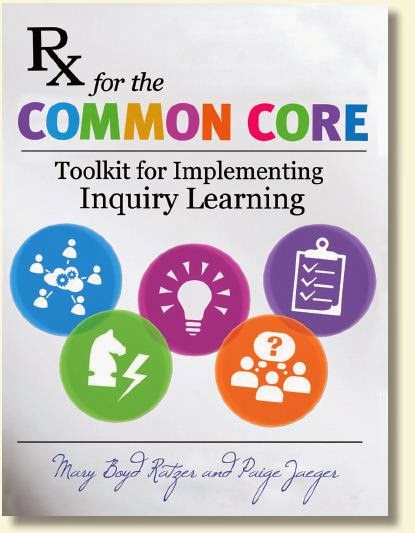
If you are wondering just how to get there, let me suggest this book.  We believe it lays out the principles of student-centered Inquiry Based Learning in an easily-digestible format.  If you wonder how you can get this message to your teachers, you may wish to read this and tab a page or two for a teacher to read.   Every page has an essential curriculum planning question at the top, and if you read that section, you should be able to understand that concept.  Some examples are:
 EQ:  How do your foster engagement and student ownership?  EQ: How does a knowledge product differ from an information product?  EQ:  What's the scoop on text-dependent questions (TDQ's)  and 33 more.  

 
Included in the book are 99 Essential Questions to help you craft student research projects for higher-level thought. It is high-time to repackage our content to get to the top of Blooms and beyond. Create a curriculum-aligned Essential Question to compel students to "uncover and discover," rather than merely standing and "covering" content.   
This book can be ordered on Amazon or directly from ABC Clio: click here  

I was privileged to work with NYS legend, Mary Ratzer on this book.  We thank all our colleagues and mentors who have taught us and led us down this Inquiry journey.  You may say this is self-serving, but in reality we are serving our students and doing them a disservice if we don't move beyond rote and recall or copy and paste assignments.  Join the journey today. 

We are available for PD in your area, if you need a hands-on day for librarians.    Here is one just one on many email feedbacks we receive.  This one from a day in Kentucky: 

'just want to thank you for the awesome PD yesterday.  I learned so much!!  At first I was kind of bummed at staying all day because I have so much to do here, but it was worth every minute J


Library Media Specialist
Beaumont Middle School


Thursday, January 23, 2014

You Tube Videos as Knowledge Product Models?

Every January we hear, view, and get solicitations for the "best of 2014" this-and-that, and I find all these intriguing.  The popularity contests in media are a barometer of cultural values. They speak volumes about what issues are beleaguering Americans; what speaks to people; where values lie; and what people are worried about.     

As I reviewed this blog posting about You Tube's Most Popular Educational Videos, I couldn't help ask...why?   In watching these great videos my mind went into overdrive thinking how these could be used to compel secondary research projects that are CCSS aligned.

When the new SS standards were released, it was interesting to note the pervasive message that kids should "research to build and present knowledge."  Students expect to do research in our schools, but what teachers lack with CCSS alignment is allowing students to creatively present their findings.    

Many teachers still are operating in the mode that students must deliver research in a written report--that will be fed into the anti-plagiarism tools  for which the districts have paid plenty of money. Dare I say that if our student's knowledge product was in the form of a video, song, infographic,  compelling speech, drama, script or some other
 Howard-Gardner-Approved format that we wouldn't have to worry about plagiarism?  


Why couldn't we ask our students to present their knowledge in this format?  


Here are a half - dozen  questions that could inspire open-ended Inquiry-Based research units eventually begging for a YouTube Instructional video - Students could create an evidence-based-claim for anyone of these: 


EQ:  Why is your chemical element important to the world?   (This could follow a close reading of the book,  The Disappearing Spoon for CCSS alignment.) 
EQ:  Why is your life better because of the scientific research which has been done for [your chosen scientific topic]? 
EQ:  Why is your life significantly better because of the Enforcement Acts of the 1870's?  
EQ:  Why does Ulysses S. Grant deserve to be on the $50.00  dollar bill?    (Reconstruction) 
EQ:  Why should we care about what we eat?  (This could follow a book such as, The Omnivore's Dilemma
EQ:  Why is the old phrase "The love of money is the root of all sorts of evil"  so apropos today - and how was this manifested in our American History? 

Unbelievable statistics below from YouTube.   If our kids are living online, you are likely to get instant engagement if you require an Evidence-Based Claim in the form of a movie.  

Insure that your students give citations  (i.e. "credits") which will add value and rigor to their movie evidence based claim. 

Statistics
Viewership

  • More than 1 billion unique users visit YouTube each month
  • Over 6 billion hours of video are watched each month on YouTube—that's almost an hour for every person on Earth, and 50% more than last year
  • 100 hours of video are uploaded to YouTube every minute
  • 80% of YouTube traffic comes from outside the US
  • YouTube is localized in 61 countries and across 61 languages
  • According to Nielsen, YouTube reaches more US adults ages 18-34 than any cable network
  • Millions of subscriptions happen each day. The number of people subscribing daily is up more than 3x since last year, and the number of daily subscriptions is up more than 4x since last year

Tuesday, December 17, 2013

Metaliteracy, Megaliteracy and Information Literacy!

Last week our local colleges and universities held a conference around METALITERACY.   Transliteracy has a partner--metaliteracy.  Reaction panel member, Richard Fogarty (History, University at Albany) shared that meta means "larger" or what comes after, and that is where our conversation finds us.  After years of talking about "transliteracy," the literacy ecosystem has evolved to metaliteracy.   This is a large habitat that is not endangered. As an afternoon reaction panel member, I had the opportunity of sharing the K-12 College and Career Readiness piece of this conversation.  Whether we are working in the K-12 environment or higher education, we are all in the same boat.  The learners of the 21st Century are not those of the 1960's and our pedagogy must include adaptations.   

I created this infographic to summarize the day's conversation and encourage educators at all levels to understand this paradigm shift.  If you need to know more, follow the links on the infographic to Metaliteracy.org  or create your own local PLC to uncover and discover what this is all about and embrace this in your information literacy instruction. 


Wednesday, December 4, 2013

Information Fashion Show: subtle faux pas


Library resources are imperative.  
Information databases are wonderful. 
Resources for research may be impressive... Your shelves are filled. But, as librarians we need to move beyond our information fashion shows and start walking the runway with talk about the research process. We live in an information-ubiquitous world, or perhaps a misinformation-ubiquitous world, and our patrons (students and teachers) will not necessarily be impressed with your resources. They  may reply, "Well I can find just as good stuff on Google, Bing, SweetSearch, or other information valets. So, I'll politely listen and then go do what I want."    

We sat at a luncheon at AASL and I couldn't help noticing how no one was paying attention to the speaker when they were telling us what we already knew.  As soon as someone started talking about topics we hadn't heard about (the research behind students' online searching behavior), they had everyone's attention.  That is where we as librarian-leaders need to head:  We need to start talking about the process of research and how that has to change.    

  • Kids have changed
  • Curriculum has changed 
  • Resources have changed, and ...
  • Research has changed 
 When you start talking about 21st Century research needs, people may listen.   


The Common Core gives us the opportunity to invite teachers to the research table.  Get your lines ready:  "Did you know Research to build and present knowledge is an anchor standard?  How can I help you meet that?"   "Did you know that students need Essential Questions to drive research reports, rather than 'information seeking' opportunities?" 

Give your teachers a holiday present this season and move beyond being a resource reservoir--model the research triage they need.   Here is a link for our teacher self-assessment tool used to awaken ah-ha moments with teachers: click here.

Monday, November 25, 2013

Removing the Guilt of Excessive Calories...and reforming research tasks

'Tis the season to spend money, eat too much, shortchange our sleep, and remember our abundant blessings.  As I contemplate which flavor pie to bake, I am reminded that people are still recovering from Super Cyclone Haiyan and living in shelters.  With 2.5 people in need of food or assistance, I am compelled to care...as I plan to cook. Here are three links to relief organizations taking donations: 


There are many other worthy organizations, but before making a donation, insure that they have their books audited for accountability.  When disaster strikes, it shouldn't matter which religion is delivering relief--as long as aid arrives.  These organizations have helped out in  areas within the continental US who have also met with recent devastation.    

It struck me that we often  are researching "facts" and disaster preparedness, but rarely embed a "response."  As students all around America study disasters, we should strive to embed a humanitarian element of response.   As we teach kids the Inquiry Cycle and they approach the last phase of "reflection"  I wonder how many of these kids have  a self-centered view of the research task.    Would it be possible to turn the research task into a research and respond, rather than a fact-fetching report gathering task where the kids are just reporting on the travesty? 

Rather than having our kids create  personal disaster plans for avoiding damage from superstorms, could we concentrate on building better relief plans?  Could knowledge products  include media plans for to help with disaster relief-- rather than PSA's about what we should do to get ready for a cyclone which will never hit [our area such as the Adirondacks of NYS]. Could we have students calculate damage and reconstruction costs and prepare FEMA presentations for weak links they found?   Now those are "real world" issues which need to be solved.   

So to assuage my guilt of consuming too many calories, I have made a donation. I wish I could do more, but at least I've done a little part.  

Wednesday, November 13, 2013

Repackaging Research for the Common Core

While preparing for my  AASL breakout session scheduled for Saturday,  I thought I'd share some documents with our virtual library world.   Many of you cannot attend this national conference in Hartford for various reasons, and we will miss meeting you face-to-face!  

Since we are all in this paradigm shift together, I thought I'd share two research tools that I crafted to help inspire your teachers to "Repackage Research" for the Common Core:  A teacher self-assessment and a student self-assessment for research--Common Core style! 

There's a great deal more in my session than these two self-assessment checklists, but in case you can't attend, I didnt want you to miss out on what I believe is an incriminating self-assessment for teachers who are caught in the old paradigm of "fetching facts." 

If you attend my Saturday morning session, we will do some hands-on activities to understand how classroom  activities can evolve into "short term or more sustained" research activities.  We will share a recipe for creating Essential Questions and attendees should leave feeling that they understand how research within the CCSS should be vastly different that the old-school, low-budget, fact-fetching lame-excuse-for-research endeavors.   As Ross Todd says, "why bother?"  


When we return to work on Monday, our NYSED governing board will be voting on whether a research paper will be a requirement (postponed until December meeting) for HS graduation.   Most high performing schools are there already,  but we all know that some schools and classroom teachers are "territorial"  and do not collaborate with their librarians.  That is not CCSS aligned and you can diplomatically inform them.    

Here is our Commissioner of Education, Dr. John King,  speaking to 1000+ NYS Network Training ELA teachers last May about "research."   Long live the King!  


Also on Friday at 8:00  we are presenting Raising eReaders:  Rising above reluctancy 
Please join us for that session, if you are sitting on the fence wondering why or how to get started with eBooks for popular fiction!    

Here is a handout from that session:  Raising eReaders (PDF -270 KB) - Friday @ 8:00 

Friday, September 6, 2013

Are You Up to CCSS Snuff?


Not very long ago, 'snuff" was not only accepted, but it was also "fashionable."*  Nicotine and soft drinks were laced with opiates and everyone was having a grand time...if they had money.  If you were really something, you were "up to snuff."   

Today in education, it is impressive if we know  how to compel our students to dig deeply, investigate, read, discover, conclude, discuss, debate, and more.  However, most educators aren't really up to snuff, yet. Some even are say it's damaging material and there should be laws against this...invasion of my classroom. 

The three links below provide self-assessment tools for measuring how well you have crafted a CCSS-aligned lesson.  Everyone is in the literacy business.  Use these "evidence guides" as toosl to improve the rigor and focus of your lessons. Please keep in mind that you do NOT have to hit all shifts and bullets in one lesson.
Lesson Evidence K-2                   Lesson Evidence 3-5              Lesson Evidence 6-12   

As I examined these three documents, which NYS is using, I discovered you could generalize this to the following checklist:
  

Your lessons should demonstrate student-centered activities where kids are manipulating information, answering text-based questions, digesting rigorous passages, vocabulary, and more.  If I were not in administration myself, I would love the opportunity to demonstrate how effectively I could support student achievement.  This is a time to shine!  


*http://www.phrases.org.uk/meanings/up-to-snuff.html