Thursday, July 23, 2009

Yo better look at Yolink!

Yo better get familiar with this new toolbar, if you want to be ahead of your students!

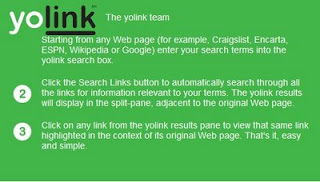
Go, YoLink ! This is the next-best thing since Google. Infact, it is so good that I'm surprised Google hadn't invented it. This toolbar enables the user (students in our case) to narrow their search very quickly. We know students don't always gravitate to the databases, and so it is necessary to at least teach them to use the Internet responsibly for information. This tool enables the search hits to be searched even deeper, and will eliminate pages that do not have your "narrower" keyword within them.
The Yolink searches the hit list and provides a little "annotation" on the side, so you don't have tohyperlink into the result to see if its relevant.

It could be used for the following:
  • Looking for a quote within a book.
  • Looking for an item on Craig's List (not the students there...)
  • Looking for hyperlinks with related information (yes, it will search deep within the hyperlinks)
  • Saving and storing searches for future use-- It has a sign in feature where they pages, links, and articles can be archived.
  • Narrowing the results within EBSCO and other databases.
  • "search links:On a webpage with a lot of links? Enter keywords into the yobox and click on search links. Looking at Google results? Just click search links and watch the magic happen." So they say....

“I think this is a fabulous tool. It's showing students how to do research with keywords, most don't understand the concept. It teaches you how to search.” -High School Librarian


Individual download site: http://www.youlink.com/
School-wide Dowloand site:

Tuesday, July 21, 2009

High Tech Cheating?

HighTech Cheating? Students See it Differently.... a wonderful post worth reading @ eschoolnews.com


The message is that a new culture necessitates a new "paradigm of teaching." Those teachers in the trenches know this all too well. We didn't write the column, but we have seen the new digital native evolve before our eyes. New appendages have grown attached to the ear and surfacing out of the pocket. These appendages connect the once analog student, to the information highway where all sources of knowledge can be found.

We need to create lessons where students have to use these resources to create knowledge products-- not recite, regurgitate or resuscitate the facts required to pass an exam.


The heart of the Common Sense Media report, "Hi-Tech Cheating: Cell Phones and Cheating in Schools," is the belief that "versatile technologies have made cheating easier." The report cites as an example that 20 percent of cell phone users ages 13-18 say they have "always/often/sometimes/rarely" used their cell phone to search the Internet for answers during a quiz or test, 17 percent have taken photos of test questions to send to friends, 25 percent have texted a friend about answers, and 25 percent have stored notes or information on their phone to look at during tests." (Evans)
We can be heartened by the statistic reported that 79% of the students at least believe it is wrong. If more tests evolved into knowledge products then we wouldn't have to worry about the appendage in the pocket. They can look information up 24-7 on an electronic database as well as Google, which are both accessible from a higher order phone.
For those educators that are fighting the cell phone tsunami, consider the paragraph below from the aforementioned eschoolnews article:
"These "free-agent learners" [students] have, to some extent, given up on their school's ability to prepare them for the world and have stepped up to assume front-line responsibility for their own learning. In a focus group last spring, I learned from students in a science class that they were regularly going online after school to check on the accuracy of what their teacher lectured about in class that day. Their teacher actually encouraged this behavior as a way for her students to gain valuable information and media literacy skills. By the way, those students in that science class were only in sixth grade, and already they were taking responsibility for their own learning process." (Evans)
So before we amputate an appendage, ask yourself: Can I change the examination to a knowledge creation or manipulation?

Thursday, July 9, 2009

The NCTE Definition of 21st Century Literacies

The NCTE Definition of 21st Century Literacies

They hyperlink above will bring you to the position statement recently released by the National Council of Teachers of English. Very Interesting... you would think they were the librarians. ELA deparments are our allies and usually work with librarians cooperatively on both reading and research endeavors. This position solidifies our "common goal". The caveat here is to build bridges across curriculums so that people will see us as a link to their vitality. Obviously, the English Departments get it. We are living in a new world, raising a new brand of students, using new tools, and addressing many new issues everyday--even though our goals are the same as they ever were: to graduate young adults who can competently function in the world in which we live. That is the currently the 21st Century.

Compare the ELA Position Statement to the AASL Standards for the 21st Century Learner:
1- Inquire, tink friticaloy, & gain knowledge
2-Draw conclusions, make informed decisions, apply knowledge to new situations, and create new knowledge.
3- Share knowledge and participate ethically and productively as members of our democratic society.
4-Pursue personal and aesthetic growth.

So, the emphasis is --keep current or the job will be embraced by those who do....