
Searching for Common Core complex text is similar to that experience for teachers. They don't know how to fish and they are coming up short. Listed below are a few tools to analyze text for Lexile levels. Use these to help find instructional resources for classroom use. In addition, I have a link below where where you can catch some primary sources.
- The Readability Statistics within Microsoft Word

- http://www.lexile.com/fab / Find a book's Lexile score at this link by either the title (upper right hand corner search box) or search for titles that are at the proper Lexile level.
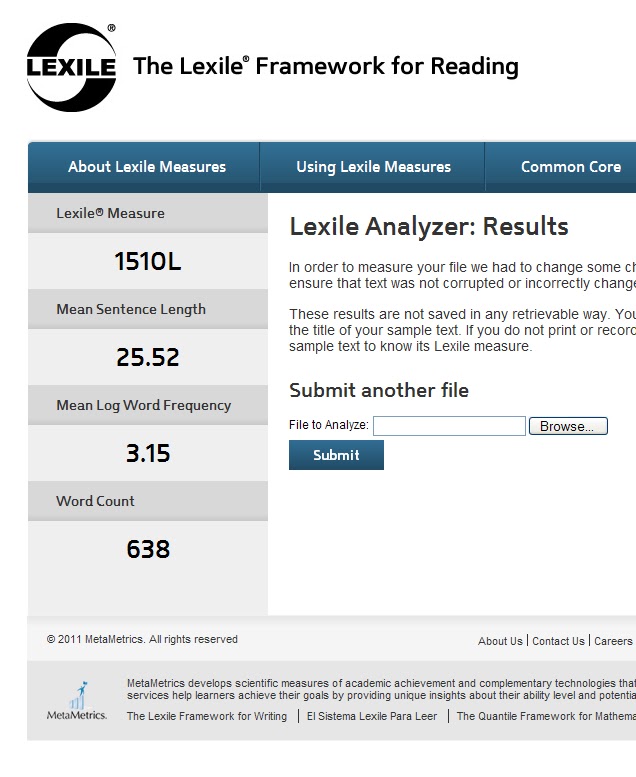
- Lexile Analyzer - http://www.lexile.com/analyzer/ Create an account and upload .txt files such as primary sources - This is the most reliable way to get a true Lexile. All the others are approximate substitutes.
- http://juicystudio.com/services/readability.php#readintro - Will analyze URL’s readability.

- http://www.readability.info/ - another place to upload a URL and get the readability of the URL/site.

In general, the “readability” ratings come in about 100 points lower than Lexiles per thousand. Therefore something with a readability index of about 850, you would likely add about 85 points to get the correlating Lexile. The Lexile.com resources by Metametrics are the most reliable. However, getting a Lexile is only one piece of the puzzle in understanding the Common Core and meeting the requirements to embed rich text with deep meaning. Teachers will want to also consider:
- Does the piece have additional opportunities to enrich learning?
- Does the piece use the vocabulary of the discipline?
- Is the piece engaging for the learner?
- Does the piece lend itself to additional research and learning activities such as debate, research, discussion, etc.


Some library OPAC's have integrated Lexile levels ... and can merge these by matching what is in the official Lexile list with what is in a library collection. Here is a link where the range of what is actually in the library appears in brackets. It' also possible to enter keywords to focus on a topic that can be used to find specific topics within a range of Lexile levels,
ReplyDeletehttp://lre.nccsd.opalsinfo.net/bin/search/arl