Showing posts with label research. Show all posts

Wednesday, September 6, 2017

What's In A Name?

Harvey's Leaving A Legacy --What will yours' be? 

As we sit warmly in the Northeast watching devastating winds and water tumble homes and communities into a path of destruction, our compassion rises and we get frustrated that there's little we can do but contribute.  We applaud the schools all across America who are rising to the fundraising challenges. This shows Americans are truly generous and kind.  

As we daily view new Harvey devastation, and fear the impending Irma, I am reminded that these real life experiences should become a teachable moments. After the waters recede and communities are being restored, we can continue to weave these real-life connections into other assignments thereby elevating relevancy--all because our students know about them. The human brain puts more priority on material which is "real"or "connected to experience. 

Pulling on a previous blog posting, I'd like to share an example of how to weave Harvey and Irma into Ivan, Mitch, Sandy, Dean, and Katrina (who's remnants still cry out). These infamous names resonate destruction and fierce strength. 

In light of the recent Hurricanes, wouldn't it be nice Seize the Day! 

  • We could build a biography unit challenging students to leave behind a living legacy of good--not evil. 
  • We could Uncover and Discover who the wonderful aid workers are. 
  • We could research and vet a list of recommended Disaster Relief Organizations.  Find out what they are all about and how much of their contributions really go directly to help--rather than administration. Communicate this list of "approved" organizations and how they help victims, communities, and recovery efforts. This is real-life.  

When a horribly huge storm leaves marks on a community, its' reputation is not good. We can turn right around and ask our students:  What's your legacy? What are you known for?
Essential Question: Why should we care about what legacy we are leaving behind?  

This essential question is a figurative way to examine a life (biography) in an introspective manner.  All too often, when school "cover" biography units, the focus is meaningless.   Kids have to report meaningless details of the Bio's life without any introspection or application.   The facts are easily recovered on a simple Google search for a website which enables the students to avoid reading the book. The Common Core calls for "relevance" and this simple re-wording of biography units can help mold character in our students. 

If biographies are repackaged we could find more meaningful constructivist assignments that ask the students to find the meaning in a life, rather than the birth-date and date of death. I don't know when Nelson Mandela's birthday is, and it doesn't matter.  I can tell you however, that he was imprisoned for principles that we all should embrace.  I can tell you that he stood for peace and equality in a sea of inequality and injustice.   I can tell you that Irene Gut Opdyke helped resist the Nazi's in Germany even though she risked her own life when she helped and hid the innocent, spied on the enemy, warned of Ghetto cleansings, and saw relatives die.  I can tell you that Condoleezza Rice arose from a humble home to a level of international ambassador. Now, those people have left footprints on the world that will never be forgotten.  


A biography unit like this could accompany any history unit where remarkable people are studied.  A research reaction to Martin Luther King could send kids out to find remarkable people with remarkable footprints. A reader and the task, reaction to Cesar Chavez study on migrant workers could lead to a footprint examination of others who have fought for a worthy cause.  This could also parallel a SS unit on a decade of change where students search for impactors (i.e. those making an impact).    They would need to persuade me as to why their choice was nominated for our "Hall of Fame Footprints!" 

When a horribly huge storm leaves marks on a community, its' reputation is not good. We can turn right around and ask our students:  What's your legacy? What are you known for?
Essential Question: Why should we care about what legacy we are leaving behind?  

Photo: http://www.state.gov/cms_images/newer2_8x10_500e.jpg

Tuesday, November 10, 2015

Thanksgiving THINKING: "Got a real problem?"

EQ: Do we have an "attitude of gratitude?"   
EQ: Are we blessed, or distressed? 

EQ: How do our personal issues stack-up against issues in the news? Are these issues being addressed?
_____________________________________________________________________

Let's face it.  We live in a world of issues, problems, disease, distress and... blessings. 
Our students, children, and family often live in either a blessed-bubble or a world of trouble. I am amazed at how often students who are from "blessed" families, embrace an attitude of oppression, while others from less fortunate situations seem optimistic despite their struggles.  

Here's an Inquiry-based lesson to challenge students to overcome struggles or over-look slight "first world problems."  My former library aide used to tell students, "You need to get a real problem." Kids would laugh and get it. Sometimes we just have to call a spade a spade. 

Activate thinking:  

  • Give each student 3 Post-it notes and ask them to write their three biggest problems--one on each note.
  • Using a bulletin board or wall, ask students to post their "problems" anonymously under the appropriate heading: "Problems" or  "Perceived Problems" 
Connect to the real world: 
  • Ask students to find articles in the newspapers of real-world issues...pictures, headlines, articles, and other items can serve as real-world connections.  
  • Post the pictures, articles, and other fodder on the board next to their "problems." 
Discuss and question: 

  • Discuss "perspective" 
  • Brainstorm questions for research 
  • Ask students to choose a "real-world issue" - Or, perhaps connect to their reading choices asking students to choose an "issue" that might be within the book.  
Research: 
  • Taking the brainstormed-questions (wonder), students can look for evidence to support their thinking.
  • Students should research their "issue" to make an Evidence-based Claim (EBC) as to why this is a problem needing to be addressed, seriously. 
  • Ask students to open their "claim" with a juxtapose comment about their "issue" compared to a real one, or acknowledging that a problem they are dealing with is a real-world issue.    
Share Knowledge - and advocate: 
  • Give the opportunity for students to "create" a poster, ePoster (Smore), technology communication product, or to create a campaign, advocate, raise money, etc... for a cause of their choice. 
  • One goal of the new C3 standards is to compel students to civil action. Let's allow them to change the world. 

If you are a librarian and don't have scheduled classes, consider collaborating with an ELA teacher, or Social Studies teacher, embarking on this learning adventure before Thanksgiving.  Let's try to challenge our students to identify real-world issues or perceived -- First world problems vs. Third World problems. 


Image: Desktop snapshot from Google image search "homeless famine"  

Post an image of your "wall" below, if you do this lesson. Thanks!  


Sunday, April 19, 2015

Questioning is the KEY for Success!

When Wiggins & McTygue launched a focus on Essential Questions, almost twenty years ago, they were ahead of the pack.  With the evolution of the Tech-dependent Millennial generation, EQ's are imperative for instruction.  The correct EQ will turn an assignment into a "discovery" to find the correct answer, using the vocabulary of the discipline!  The wrong assignment question will provide nothing more than a fact-fetching online session.

 EQ's can  transfer the learning responsibility into the student's hand and prevent the scenario pictured below. 
 

(Text from Sorry You're Lost, by Matt Blackstone) 

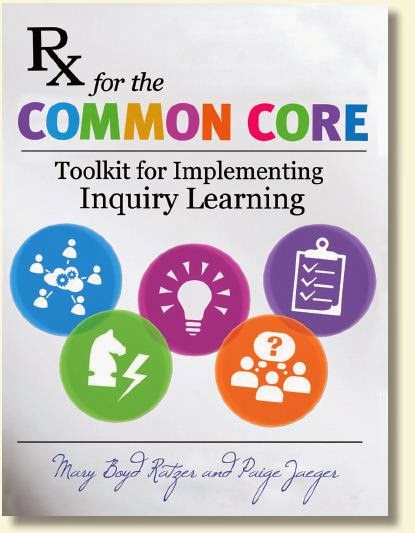
I'll be delivering PD on this Monday morning, in Missouri --for any educator attending MASL Conference, but most reading this will not be in Mark Twain territory for this event.  Listed below are a few sample EQ's which demonstrate how the right EQ can empower a student to learn.  These samples are 9 examples of the 99 Essential Questions found in our book, Rx for the Common Core, available via Libraries Unlimited.  (Use discount code: Q21520 for 20% off.)

EQ: Why do we need to be concerned about Plate Tectonics and your local plate.  
EQ: How is health and wellness defined by the technology of the time? 
EQ: How has the discovery of [your Chemical Element] changed the world?
EQ: How has the migration of people, changed the culture where they landed? 
EQ: How did Jim Crow cause the South to revert to a pre-Civil Way society?
EQ: How do animals think like scientists?
EQ: If you were living in Europe during the 1700's, would you have emigrated to America? 
EQ: How did scurvy impact sailing? 
EQ: Why is your digital footprint a real-world character reference

I'll be talking about EQ's, GQ's (Guiding Questions), TDQ's (Text-dependent Questions), and more, on Monday!  See you if you are in the area!  


Thursday, March 12, 2015

Eavesdropping Barbie a Smash Hit for Instruction!

Wow.  When I read in the Washington Post  about Mattel's new "eavesdropping Barbie," my adrenaline started to flow with the thought of instructional possibilities: Close Reading discussion and debate, seed text for research, CyberSafety, Patriot Act, Right to privacy, Bill of Rights, and more.  Just think about this Essential Question which would spark curiosity setting the stage for focused reading: 


EQ: Has technology evolved beyond its' own good?  

Guiding Questions for discussion or Text-dependent Questions: 
  • How do toys reflect the culture? 
  • Is there a potential for criminal activity? 
  • Would the Bill of Rights have anything to do with this? 
  • Would the Patriot Act have anything to do with this? 
  • Has Mattel toy company exceeded "childish" things with this new Hello Barbie
  • How does talking Barbie compare to talking Elmo? Why is it okay for Elmo to talk, but not Barbie...in this case? (This is an example of a TDQ which gets the kids to examine the text to see that it's not the talking that's the issue--but rather the listening.) 
This sample close reading piece measures a 10.5 on the Fleisch-Kincaid reading measure making it so appropriate for a great HS discussion piece.  It even has ample of great Tier 2  (SAT words) vocabulary words such as: Advocacy, advocates, affinity, subtle, vulnerable, confide, and more. If an ELA class was reading Brave New World, 1984, or some other dystopian novel, this could be paired with it to bring the material into the real world.  

 
(If you don't know how to measure readability statistics, read this blog posting: Click here )

Now we know that not everyone will be able to use this gem from the Washington Post. It is not a primary source document from the Library of Congress.  However, This is an example of using a short Close Reading piece to instigate a discussion --> which leads kids to conclude they don't know enough--> which leads to research to find the answers.  

For those people who need reading material of greater "substance" - consider pairing this with an excerpt from Chief Justice Louis Brandeis' dissenting opinion on the landmark "right to privacy" case of 1928.  Read this paragraph and see how appropriate his words were almost 100 years ago: 
  • MR. JUSTICE BRANDEIS, dissenting. . . . By objections seasonably made and persistently renewed, the defendants objected to the admission of the evidence obtained by wire-tapping, on the ground that the Government’s wire-tapping constituted an unreasonable search and seizure, in violation of the Fourth Amendment; and that the use as evidence of the conversations overheard compelled the defendants to be witnesses against themselves, in violation of the Fifth Amendment.   ...."Moreover, “in the application of a constitution, our contemplation cannot be only of what has been but of what may be.” The progress of science in furnishing the Government with means of espionage is not likely to stop with wire-tapping. Ways may someday be developed by which the Government, without removing papers from secret drawers, can reproduce them in court, and by which it will be enabled to expose to a jury the most intimate occurrences of the home. Advances in the psychic and related sciences may bring means of exploring unexpressed beliefs, thoughts and emotions. “That places the liberty of every man in the hands of every petty officer” was said by James Otis of much lesser intrusions than these. To Lord Camden, a far slighter intrusion seemed “subversive of all the comforts of society.” Can it be that the Constitution affords no protection against such invasions of individual security? . . .  
After this close reading, discussion and debate, a teacher and librarian would again ask the students the Essential Question:  Has technology evolved beyond it's own good?  
Or, is technology a help or a hindrance? 
Ask your students: What else do you want to know about this?  

This is real life research. This is a life-long learning skill. This is relevant to their lives.  This fosters engagement. This is how we slowly make the paradigm shift to student-centered instruction.  Share this with a teacher who is wondering how to foster the "short term" research assignments that the CCSS says should be an "anchor standard." 


Friday, January 30, 2015

Skip a Pizza...Feed the World?

While driving this morning, I heard "news" that Pizza Hut expects to have 60,000 drivers on tap Sunday for an expected 2 Million orders.  I said, "Wow. And, that's only a piece of the pie!"  


Pizza Hut is only one American pizza vendor. There's Papa Johns, Dominos, and Little Caesars--to say nothing of the local pizza joints serving up splendid treats.   If we conservatively assume 4 major vendors, each serving 2 million pies, Americans will easily consume over 8 million pizzas this Superbowl Sunday.  That's in addition to the 1.23 Billion Chicken Wings (that's billion with a "B"...) TBC (to be consumed) as reported by USA today.    

Let's look at this through our SS lenses which want us to compel kids to "civic action."  Here's a quick outline for a relevant SS - Civic Action lesson:  Present students with the facts and ask them what they think.  

  • Use this USA Today article as a "seed text." (Or, find a more recent one if you can.) This text comes in at a Fleisch Kincade HS level appropriate for 11th-12th grade. 
  • Hold an "evidence-based discussion" and see what their reaction is.  Do they see this as a national economic shot in the arm?  Do they see this event as a social holiday or dietary travesty?  Your EQ could be:  How does the Superbowl Affect America and Americans? 
  • After the discussion, ask them what other questions they have.  Aggregate the questions and ask them all to choose 2 or 3  to investigate.  Each investigation becomes their own "inquiry path."  
  • Proceed to your library for a short-term research project to look up additional facts, research, and to dig deeper into the affect of the Superbowl upon Americans.  - Make no bones about it: This is a major economic event. Calculate the expenditures for your locality alone.  
  • As a learning concierge, guide the question brainstorming to include other geographic areas that are suffering from famine.  (Have pictures queued-up?)
  • Final knowledge product suggestions: Infographic to inform and advocate in the form of an Evidence-based Claim?  Evidence-based discussion and debate.  Local advocacy: "Skip a pizza - Feed the Poor?"  
  • Let students extrapolate the impact of [4] million homes replacing the cost of one pizza with a donation.  How many hungry people could we feed with that sum? 
I just did it.  I don't need the 300 calories in 1 slice.  I have my Rotel and Velveeta I can munch.  Enjoy the game and... your wings! 

Here are three good links, in case you're convicted.  

Tuesday, January 27, 2015

Is P the new "Scarlet Letter" ??


From: pleasedontcheat.com 

If you are looking for ideas to combat Plagiarism...look at re-designing your own assignment. At a recent discussion group around Plagiarism, it was acknowledged that most of the plagiarized assignments could benefit from student-centered repackaging. All too often a teacher pre-designs what the students need to investigate and thereby the assignment reflects the teacher, not the student.  This type of assignment is most frequently plagiarized.

Ask the Shadow Scholar:  


His story is unbelievable -- Only we do believe it, because we know it's widespread.  We've seen it. We even empathize with a poorly assigned paper that requires very little synthesis and conclusions.  Here are five first steps or simple suggestions, to help combat Plagiarism:  
You may know this, but perhaps some teachers do not.  Or, in our busy-over-burdened educational paradigm, we have not left enough time for coaching, progress monitoring, and guidance so that we can insure that students are actually doing their work and not copy-pasting.  Embedding an element of choice transfers ownership to the student.  If a teacher has "pre-defined" what the topic is (without an element of choice), it is the teacher's assignment and not the student's work.  We are teaching a self-centered generation that wants to "own" their work and doesn't always like to be told what to do.  I trust this is not a news-flash....

eProducts such as Noodletools and Easybib certainly help a student learn how to paraphrase correctly and provide great opportunities for instruction.  However, we know that there is a huge digital divide in some schools.  Whether in a techy or non-techy environment, our goals should be the same: Originality. Thinking. Synthesis.  Original conclusions.  Deep understanding. 

So, is P the new scarlet "S"?  - No.  This generation doesn't care.  There's no shame in Plagiarism....or so they think.  We know better, and need to model why.  


Friday, January 23, 2015

Wall of Shame? Or, Wall of Fame?

On our collegial listserv, operating as an informal PLC, someone asked for ideas on a 
R-E-S-P-E-C-T  or Dignity character education lesson.  I thought I'd share my response as an example of "repackaging" a lesson into an Inquiry-based Learning adventure.  This is something that might fit our new moniker "Mininiquiry" or a short research project that can be done in a lesson or two -- as compared to a "more sustained" research project.  

The CCSS calls for research to build and present knowledge to be an "anchor standard."  Have your teachers dropped anchor in your domain lately?  Here's one idea for them! 

____________________________________________________________________

Original email request:

"A 6th grade teacher just came to me. She is doing a project on "respect"
and "dignity" with her class and I am trying to help her come up with a
way for her kids to research this. (She originally just wanted the
computer lab where she was going to let her kids loose on the Internet -
until I stepped in and said, "Let me teach the class").

She doesn't even know yet what the final project will be - a paper? a
PSA? a trifold board? So I don't have a lot to go on...."

_________________________________________________________________________
Here are some possible thoughts to digest: 

* Begin with the end in mind —  You are correct that your teacher needs to
determine the final "knowledge product” (I.e. How will they show they have
learned the material - What do you want your students to KNOW or BE ABLE
TO DO)
* Final knowledge products should be linked back to the "big idea" - in  this case respect and dignity.
* She needs an essential question to hook the students into the relevance.
* So with all that in mind here¹s just 1 simple idea:

EQ:  If you were to build a "Wall of Fame"  and a "Wall of Shame" for
respect and dignity, who would be on it and why?   —  Build an EBC.

With an EQ like that, they are beginning with the end in mind.
  • This is student-centered. - They are in control of their search
  • They will think like “historians" - cause and effect  - historical heroes, etc. (You could align this with a historical “era" to hit a SS standard,etc.)
  • This is Inquiry based as they have choice and a voice.
  • It might help for the class to brainstorm together (Wonder) the characteristics of “respectful” or “dignified" people.  You could even activate thinking by having copies of newspapers or TIME magazines and ask them to find people currently who would qualify for either side.  Ask why?  That will incubate the thoughts of characteristics for either side.
  • These characteristics may become some of the keywords for searching.*   This also gives you an opportunity to use either a biography database, a newspaper database, or other resources and teach narrowing your search.
  • It also allows them to build an EBC (evidence-based claim) to support their answers. This correlates to ELA standards. 
  • This allows an easy way to layer technology via many different apps such as collage.com 
  • This is also not technology-dependent, if your school lacks it. 
  • The new C3-SS Standards encourage kids to get to “civic action.”  This is a perfect lesson to incubate that response.
  • Include a slogan for the school? - Create a slogan for “dignity.”  (Have them visit www.sloganizer.net to create one…if it’s not blocked in your school.  Choose the English version not the German.)


Friday, April 25, 2014

Googling is NOT College and Career Readiness

This morning I received a desperate plea from a super-librarian who has seen her program go down-the-tubes with the arrival of one-on-one devices incorrectly implemented in silo-classrooms.   What a shame.  As a district adopts a new "writing program" with built-in research tasks,  old tasks get dropped in order to accommodate new instructional models that have been crafted to increase someone's bottom line. 

Ironically,  this school with a flexible schedule to allow for innovative learning endeavors, is reverting to a model of one-size-fits-all learning tasks demoralizing a cutting edge model of flexible scheduling to accommodate curriculum needs. 

If this sounds like your scenario, please wrap your head around a few poignant truths for advocacy.   These three teacher-assessment questions below are a great starting ground to discuss at faculty meetings, principal appointments or in the lunchroom.   Simple truths such as these may help to open research collaboration doors.   These are merely three of many possibilities, but are effective one-liners to help secure and maintain your foothold in research--in spite of new writing programs, learning modules, or other packaged products that arrive in your building!  


Inherent in transforming information is synthesis and a conclusion….  Transfer requires only reporting of data without deep understanding.  Most commercially-sold writing programs do not understand this.   If assignments don’t include an element of transforming information, they are low level thought and do NOT meet our state’s model of investigation nor the objectives of the Common Core.    

·   We are living in an Age of Misinformation – not the information age. – Students need to learn how to access information as well as synthesize it to draw conclusions.  This is college and career readiness.  Not, finding information on Google or mere vetted websites and jotting those notes into a pro-forma document or virtual index cards.  

·    We are also living in a data-driven world and so this data below should speak.

·   The PARCC tests will be 30% based upon correct “research” – If your students are not learning how to research,  they will NOT score well on the PARCC tests.    See this link:  http://www.parcconline.org/mcf/english-language-artsliteracy/structure-model-content-frameworks-elaliteracy    
  
Or, read this language from the PARCC site.   (Incidentally, the Smarter-Balance tests are also based about 25% on a research task.)  I loathe the invasive testing paradigm, but if it will help you advocate for necessary instructional time, then play that card! 

Research project: The Model Content Frameworks give special prominence to research tasks, reflecting the deep connection research has to building and integrating knowledge while developing expertise on various topics. When possible, research should connect to texts selected for close readings, requiring students to closely read and compare and synthesize ideas across multiple texts. One avenue within the Model Content Frameworks is to ask students to extend their analytical writing on a text or texts by gathering additional information as part of a research project. Through a progression of research tasks, students are called on to present their findings in a variety of modes in informal and formal contexts appropriate to the grade level (e.g., through oral presentations, argumentative or explanatory compositions, or multimedia products).   
[http://www.parcconline.org/mcf/english-language-artsliteracy/research-project-1 ]

So, do your best to advocate for your instructional foothold.  A purchased curriculum package should not displace a person who is capable, equipped, and connected!  

At the New England Library Association conference where I help pre-conference PD a few weeks ago, I met many great librarians who also bemoaned this scenario.  We jokingly said we'd come up with a 12-Step program for recovery.  Well, we've done better than that!   We've boiled it down to 5 simple steps, because we know that brain research says the brain can't remember more than 4 at a time! 
  1. Administer the Google litmus test 
  2. Insert Essential Question at the beginning which will foster synthesis of those facts and conclusions 
  3. Require credible library resources to be used 
  4. Embed technology for engagement - somewhere 
  5. Insure that students have an opportunity to "present" their knowledge 
Now we really know that there is more to it than that, but these simple 5 will not scare them away from "Repackaging Research" 


Friday, February 14, 2014

Sloganize Your Research!

Today while virtually chatting with a colleague, she shared that she was still looking for a great graphic to represent our "Research Ambassador"  program.   We are turning out capable research change-agents and are proud of the role our Cybrarians are playing in transforming low-level-lame research units into deep learning endeavors that are aligned with the goals of the Common Core.    

We can view the Common Core as instruction that librarians have been advocating for over that last ten years.  Whether you are in a CCSS state, or not, the anchor standard, research to build and  "present knowledge," is a great goal.  Why else do research?  To sit on the findings?  To merely write a paper?    Research without presentation, is like a jeweler buying a gem and not putting it in a ring. 

When kids used to complete their research early in my library, I would differentiate the assignment and ask them to "sloganize" their findings.  If it were a biography, I'd ask them to get to the heart-and-soul of that person and create a slogan they might use in advocacy.    If it were an explorer, I'd ask them to choose three words that would best describe that person.  Or, to sum up the findings of their [issue] such as homelessness, I may have asked them to find a saying for their thesis. 

Having just finished reading  Sheinkin's book, The Bomb, I was wondering what Sloganizer would come up with if I tried to summarize Oppenheimer's mission.  I brainstormed three words that Oppenheimer might have chosen:  fusion finish first.   Here's what Sloganizer came up with for Robert Oppenheimer: 

This simple fun task can wrap up a "project" that may be less-than-stellar.  If a teacher hasn't collaborated and the kids are merely completing a deadly "packet,"  It instantly gives them a crumb at the top of Bloom's taxonomy. To summarize and create an enduring understanding is a tough task.    If you type that into the sloganize box, you can continue to hit the button until you get one of 500 them and variations you may like.  Here's what Patrick Henry might have chosen: 

While I chatted with a colleague via email,  I thought of using the old tool that I would send kids to for this purpose.  I wanted to come up with some short slogan to add to our Research Ambassador's bootcamp.  Here's a sampling of what sloganizer created. 

 
or 

So while I may not have found a graphic, I am close to a slogan!  
 From these I may choose a hybrid...  Research  Builds Brains and Empowers People

Have some fun today, and ask your students where else they could use this?  What would your inventor have sloganized for his invention?  What would the main character of the book have advocated for?  

www.sloganizer.net  - Choose the English Tab 

Thursday, January 30, 2014

Can your students think?

Yesterday I talked with a Superintendent in Pennsylvania, and he was complaining how kids can't think.   "They cut and paste, they want to fill in the blank and that's it,"  he said.  "We need problem solvers and our teachers are merely conveying content." 

Later, President Obama agreed with him when he made this statement in the State of the Union address: 
 "Teachers and principals in schools from Tennessee to Washington, D.C. are making big strides in preparing students with skills for the new economy – problem solving, critical thinking, science, technology, engineering, and math.  Some of this change is hard.  It requires everything from more challenging curriculum and more demanding parents to better support for teachers and new ways to measure how well our kids think, not how well they can fill in a bubble on a test.  But it’s worth it – and it’s working."  

If you are wondering just how to get there, let me suggest this book.  We believe it lays out the principles of student-centered Inquiry Based Learning in an easily-digestible format.  If you wonder how you can get this message to your teachers, you may wish to read this and tab a page or two for a teacher to read.   Every page has an essential curriculum planning question at the top, and if you read that section, you should be able to understand that concept.  Some examples are:
 EQ:  How do your foster engagement and student ownership?  EQ: How does a knowledge product differ from an information product?  EQ:  What's the scoop on text-dependent questions (TDQ's)  and 33 more.  

 
Included in the book are 99 Essential Questions to help you craft student research projects for higher-level thought. It is high-time to repackage our content to get to the top of Blooms and beyond. Create a curriculum-aligned Essential Question to compel students to "uncover and discover," rather than merely standing and "covering" content.   
This book can be ordered on Amazon or directly from ABC Clio: click here  

I was privileged to work with NYS legend, Mary Ratzer on this book.  We thank all our colleagues and mentors who have taught us and led us down this Inquiry journey.  You may say this is self-serving, but in reality we are serving our students and doing them a disservice if we don't move beyond rote and recall or copy and paste assignments.  Join the journey today. 

We are available for PD in your area, if you need a hands-on day for librarians.    Here is one just one on many email feedbacks we receive.  This one from a day in Kentucky: 

'just want to thank you for the awesome PD yesterday.  I learned so much!!  At first I was kind of bummed at staying all day because I have so much to do here, but it was worth every minute J


Library Media Specialist
Beaumont Middle School


Wednesday, December 4, 2013

Information Fashion Show: subtle faux pas


Library resources are imperative.  
Information databases are wonderful. 
Resources for research may be impressive... Your shelves are filled. But, as librarians we need to move beyond our information fashion shows and start walking the runway with talk about the research process. We live in an information-ubiquitous world, or perhaps a misinformation-ubiquitous world, and our patrons (students and teachers) will not necessarily be impressed with your resources. They  may reply, "Well I can find just as good stuff on Google, Bing, SweetSearch, or other information valets. So, I'll politely listen and then go do what I want."    

We sat at a luncheon at AASL and I couldn't help noticing how no one was paying attention to the speaker when they were telling us what we already knew.  As soon as someone started talking about topics we hadn't heard about (the research behind students' online searching behavior), they had everyone's attention.  That is where we as librarian-leaders need to head:  We need to start talking about the process of research and how that has to change.    

  • Kids have changed
  • Curriculum has changed 
  • Resources have changed, and ...
  • Research has changed 
 When you start talking about 21st Century research needs, people may listen.   


The Common Core gives us the opportunity to invite teachers to the research table.  Get your lines ready:  "Did you know Research to build and present knowledge is an anchor standard?  How can I help you meet that?"   "Did you know that students need Essential Questions to drive research reports, rather than 'information seeking' opportunities?" 

Give your teachers a holiday present this season and move beyond being a resource reservoir--model the research triage they need.   Here is a link for our teacher self-assessment tool used to awaken ah-ha moments with teachers: click here.

Wednesday, November 13, 2013

Repackaging Research for the Common Core

While preparing for my  AASL breakout session scheduled for Saturday,  I thought I'd share some documents with our virtual library world.   Many of you cannot attend this national conference in Hartford for various reasons, and we will miss meeting you face-to-face!  

Since we are all in this paradigm shift together, I thought I'd share two research tools that I crafted to help inspire your teachers to "Repackage Research" for the Common Core:  A teacher self-assessment and a student self-assessment for research--Common Core style! 

There's a great deal more in my session than these two self-assessment checklists, but in case you can't attend, I didnt want you to miss out on what I believe is an incriminating self-assessment for teachers who are caught in the old paradigm of "fetching facts." 

If you attend my Saturday morning session, we will do some hands-on activities to understand how classroom  activities can evolve into "short term or more sustained" research activities.  We will share a recipe for creating Essential Questions and attendees should leave feeling that they understand how research within the CCSS should be vastly different that the old-school, low-budget, fact-fetching lame-excuse-for-research endeavors.   As Ross Todd says, "why bother?"  


When we return to work on Monday, our NYSED governing board will be voting on whether a research paper will be a requirement (postponed until December meeting) for HS graduation.   Most high performing schools are there already,  but we all know that some schools and classroom teachers are "territorial"  and do not collaborate with their librarians.  That is not CCSS aligned and you can diplomatically inform them.    

Here is our Commissioner of Education, Dr. John King,  speaking to 1000+ NYS Network Training ELA teachers last May about "research."   Long live the King!  


Also on Friday at 8:00  we are presenting Raising eReaders:  Rising above reluctancy 
Please join us for that session, if you are sitting on the fence wondering why or how to get started with eBooks for popular fiction!    

Here is a handout from that session:  Raising eReaders (PDF -270 KB) - Friday @ 8:00 

Sunday, October 20, 2013

Synthesis and Smoothies

I love smoothies as they are the greatest for life-on-the-run. In the morning the blender gets filled with kale, walnuts, soy milk, bananas, blueberries and flax seed for a breakfast shake that rivals the mulch-pile. These seemingly unrelated ingredients get pulverized--synthesized--into a high-powered drink that sticks with me. That is what we long to see in our students -- Synthesis of seemingly unrelated ingredients (information) into a smooth conclusion supported by evidence.  

Two years ago when we ventured down our Repackaging Research campaign, we had stickers printed that say, "I SYNTHESIZE." These are coveted in our libraries and distributed and worn as a badge of honor when students conclude, or make sense of, information they have found. Even high school students prize the recognition, says Jan Tunison of Scotia-Glenville High. Yesterday a colleague posted on a listserv that she was looking for tips on Synthesis and it compelled me to share a few thoughts to encourage synthesis: 

  • Research should be packaged as a question in need of an answer 
  • If a student only has to find facts and spit them out, they will not get to the synthesis stage 
  • Synthesis comes when they have to answer a question, based upon the facts  
  • When they synthesize their facts, they usually draw a conclusion based on evidence (facts) and that becomes their hypothesis about which they write.   


Students have trouble synthesizing because they have spent years merely "fetching facts."    
(See my fetching facts post here..x.

In our upcoming book, Rx for the Common Core, we have a few pages on synthesis and a number of graphic aids to help teachers and librarians foster synthesis in their research reports.  

Monday, October 7, 2013

Voki - Avatars - Crazytalk and Other Pseudo Friends

This hyper-connected generation loves technology, but unfortunately, it is not a panacea for high performance. It is a tool for engagement, or to entice students to have fortitude to complete the assignment.    Opportunities to embed technology are endless, but with the CCSS technology should take a back seat to higher level thought.  

(See this previous post for an example of Teddy Roosevelt CrazyTalk speaking to America...This was crafted during the first Obama run for presidency, after a student had done his research.) 

Teaching should not be about the technology.  It should be about the synthesis of information and reporting those conclusions via a 21st Century tool.    Technology will also help you engage the learner to "hear" a message that would be tuned-out via verbiage, text or talk.   Here's one of those for example.... It's that time of year I resurrect my Voki witch, ala Wicked Witch of the West, to remind students to not copy and paste:  https://tinyurl.com/y58wwa5t 


Listed below are some sample essential questions that could be used for research reports that are Common Core aligned, using Vokis, Xtranormal, Crazytalk, or other avatar generator tools.   For each question, notice the synthesis of "facts" required to answer the question.  If your teachers are crafting research to "fetch facts"  and not do anything with those facts, they are not Common Core aligned.   Higher level thought is developed by requiring kids to think, conclude and create something with their "facts."  


CURRICULUM CONTENT
EQ
Explorers
How did geography impact your exploration?
Colonists
What would your colonist say to America today?
Presidents  - US or other national leaders
What was the lasting legacy of your presidency and why?  Have we treasured or trashed this today?
Mathematicians
How did your mathematical discovery impact our life today?
Scientists
How did your discovery improve our life, products, or future?  Why should we be grateful for your hard work?
Inventors
Convince me, your peer,  to fund your invention.  How will it improve my life? 
Planets
Why does the sun deserve the golden globe award?  What should be the official number of planets in our solar system?
 
If your teachers are not researching, perhaps they need an invitation from you.   Create an avatar model and suggest an alternative to a previous typically low-budget thought research paper that comes through your door.    

Students should be building an evidence-based claim.  Each one of the above affords the students to dig up facts to support a "claim."  Notice how for each of these projects, technology is not embedded until the end--after a student has done the digging and synthesizing.   This becomes the "knowledge product."    Why you could even do these witches for your own library curriculum asking, "How is information organized?"    

And, if your school doesn't have the technology to create these Avatars, or your technology doesn't support Flash yielding it unable to do this...create an alternative.  Perhaps a video, speech, or simple audio recording on a www.thinglink.com  would do the same!