Showing posts with label Inquiry Based Learning. Show all posts

Sunday, April 19, 2015

Questioning is the KEY for Success!

When Wiggins & McTygue launched a focus on Essential Questions, almost twenty years ago, they were ahead of the pack.  With the evolution of the Tech-dependent Millennial generation, EQ's are imperative for instruction.  The correct EQ will turn an assignment into a "discovery" to find the correct answer, using the vocabulary of the discipline!  The wrong assignment question will provide nothing more than a fact-fetching online session.

 EQ's can  transfer the learning responsibility into the student's hand and prevent the scenario pictured below. 
 

(Text from Sorry You're Lost, by Matt Blackstone) 

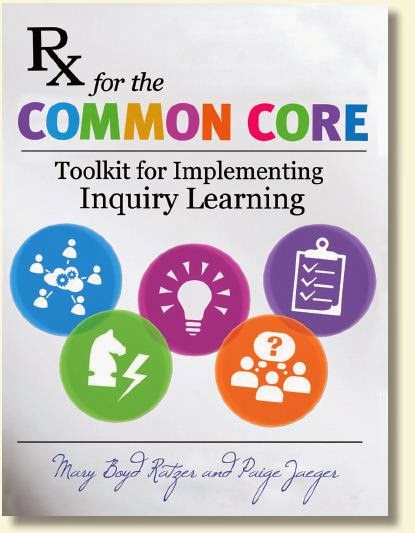
I'll be delivering PD on this Monday morning, in Missouri --for any educator attending MASL Conference, but most reading this will not be in Mark Twain territory for this event.  Listed below are a few sample EQ's which demonstrate how the right EQ can empower a student to learn.  These samples are 9 examples of the 99 Essential Questions found in our book, Rx for the Common Core, available via Libraries Unlimited.  (Use discount code: Q21520 for 20% off.)

EQ: Why do we need to be concerned about Plate Tectonics and your local plate.  
EQ: How is health and wellness defined by the technology of the time? 
EQ: How has the discovery of [your Chemical Element] changed the world?
EQ: How has the migration of people, changed the culture where they landed? 
EQ: How did Jim Crow cause the South to revert to a pre-Civil Way society?
EQ: How do animals think like scientists?
EQ: If you were living in Europe during the 1700's, would you have emigrated to America? 
EQ: How did scurvy impact sailing? 
EQ: Why is your digital footprint a real-world character reference

I'll be talking about EQ's, GQ's (Guiding Questions), TDQ's (Text-dependent Questions), and more, on Monday!  See you if you are in the area!  


Tuesday, June 17, 2014

3 Simple Summer Goals?


     Next to December, June is about the busiest month of the year-- only no one is singing carols or baking goodies.  We're all bemoaning grading, taking inventory, and shouting things like, "Who cares if the book is out of order! Would someone kill that beeper?!"  
     We spend time hunting down book thieves and rummaging in lockers for MIA titles. We wish for one of those little "Do not disturb" signs from the Hilton and long for a chamber maid to arrive to tackle housekeeping. If we're lucky, someone has stopped to wish us a nice vacation and remind us why we enjoy working with these packages of adolescent hormones.   (Disclaimer:  I was a middle school librarian for about 10 years...)
     By the time we get poolside drinking [soda] with little umbrellas, we have 10% more gray hairs and a few less brain cells.  We've baked the cookies and eaten dozens claiming we deserved them and we desperately hope to rouse up a little patience for our own kids.   

Fast forward three weeks: 
  • Yes.  I did agree to the PLC and where is that book? 
  • Yes.  I did take home ten books to read so that I can recommend good books. 
  • Yes.  I did agree to look at Piktochart and learn how to create infographics. 
  • Yes.  Perhaps I can find time to read
To keep yourself professionally equipped in our tsunami of change, we can't afford to ignore our profession during this extended time of respite. Just as the kids experience the "summer slide," professionals often take on a Rip-VanWinkle persona and wish that everyone will just leave us alone.  Educational changes are make us feel like we're in a NASCAR race and to keep current, we need a little inspiration.  

Three goals seem manageable.  Three goals are easy to meet.  Three is a friendly do-able number.  Take time for yourself and family, but also take time to equip yourself for change.  Partner with a colleague, listserv, or PLC for accountability.  Here are 3 simple goals to embrace: 
If you don't know where to start, here are a few ideas:
  • Review the narrative nonfiction winners and pick a few
  • Review the Newbery and Printz award winners and pick a few
  • For professional reading... you can "do" twitter, but Twitter is often a surge of surface reading.  It's great-don't get me wrong.  I tweet.  I read tweets, and I follow links for ideas.  But that's like being fed with breadcrumbs.  Occasionally, you really need a meal.  There are great professional books which will help you equip yourself for our changing educational world.  Here are a few that I recommend in order to equip yourself with the tools for Inquiry, Common Core, and the latest buzzword for libraries...Makerspaces. Choose one and enjoy it with a friend, poolside, sipping soda and making plans. 
Essential Questions - because it is a vital skill to understand.  It enables us to move away from rote 'n recall.
Rx for the Common Core - because I wrote it and know it's easy to read, packaged for easy understanding and will equip an educator with a plethora of skills for the CCSS, Inquiry Based Learning, questioning, and higher level thought.
Teaching for Inquiry - because everything that these authors write is good.  It will equip you with a strong foundation in Inquiry Based Learning.
School Library Makerspaces - because this is the latest buzzword and we should understand this...in order to weave this into our learning common space. 
 

Thursday, January 30, 2014

Can your students think?

Yesterday I talked with a Superintendent in Pennsylvania, and he was complaining how kids can't think.   "They cut and paste, they want to fill in the blank and that's it,"  he said.  "We need problem solvers and our teachers are merely conveying content." 

Later, President Obama agreed with him when he made this statement in the State of the Union address: 
 "Teachers and principals in schools from Tennessee to Washington, D.C. are making big strides in preparing students with skills for the new economy – problem solving, critical thinking, science, technology, engineering, and math.  Some of this change is hard.  It requires everything from more challenging curriculum and more demanding parents to better support for teachers and new ways to measure how well our kids think, not how well they can fill in a bubble on a test.  But it’s worth it – and it’s working."  

If you are wondering just how to get there, let me suggest this book.  We believe it lays out the principles of student-centered Inquiry Based Learning in an easily-digestible format.  If you wonder how you can get this message to your teachers, you may wish to read this and tab a page or two for a teacher to read.   Every page has an essential curriculum planning question at the top, and if you read that section, you should be able to understand that concept.  Some examples are:
 EQ:  How do your foster engagement and student ownership?  EQ: How does a knowledge product differ from an information product?  EQ:  What's the scoop on text-dependent questions (TDQ's)  and 33 more.  

 
Included in the book are 99 Essential Questions to help you craft student research projects for higher-level thought. It is high-time to repackage our content to get to the top of Blooms and beyond. Create a curriculum-aligned Essential Question to compel students to "uncover and discover," rather than merely standing and "covering" content.   
This book can be ordered on Amazon or directly from ABC Clio: click here  

I was privileged to work with NYS legend, Mary Ratzer on this book.  We thank all our colleagues and mentors who have taught us and led us down this Inquiry journey.  You may say this is self-serving, but in reality we are serving our students and doing them a disservice if we don't move beyond rote and recall or copy and paste assignments.  Join the journey today. 

We are available for PD in your area, if you need a hands-on day for librarians.    Here is one just one on many email feedbacks we receive.  This one from a day in Kentucky: 

'just want to thank you for the awesome PD yesterday.  I learned so much!!  At first I was kind of bummed at staying all day because I have so much to do here, but it was worth every minute J


Library Media Specialist
Beaumont Middle School


Wednesday, November 13, 2013

Repackaging Research for the Common Core

While preparing for my  AASL breakout session scheduled for Saturday,  I thought I'd share some documents with our virtual library world.   Many of you cannot attend this national conference in Hartford for various reasons, and we will miss meeting you face-to-face!  

Since we are all in this paradigm shift together, I thought I'd share two research tools that I crafted to help inspire your teachers to "Repackage Research" for the Common Core:  A teacher self-assessment and a student self-assessment for research--Common Core style! 

There's a great deal more in my session than these two self-assessment checklists, but in case you can't attend, I didnt want you to miss out on what I believe is an incriminating self-assessment for teachers who are caught in the old paradigm of "fetching facts." 

If you attend my Saturday morning session, we will do some hands-on activities to understand how classroom  activities can evolve into "short term or more sustained" research activities.  We will share a recipe for creating Essential Questions and attendees should leave feeling that they understand how research within the CCSS should be vastly different that the old-school, low-budget, fact-fetching lame-excuse-for-research endeavors.   As Ross Todd says, "why bother?"  


When we return to work on Monday, our NYSED governing board will be voting on whether a research paper will be a requirement (postponed until December meeting) for HS graduation.   Most high performing schools are there already,  but we all know that some schools and classroom teachers are "territorial"  and do not collaborate with their librarians.  That is not CCSS aligned and you can diplomatically inform them.    

Here is our Commissioner of Education, Dr. John King,  speaking to 1000+ NYS Network Training ELA teachers last May about "research."   Long live the King!  


Also on Friday at 8:00  we are presenting Raising eReaders:  Rising above reluctancy 
Please join us for that session, if you are sitting on the fence wondering why or how to get started with eBooks for popular fiction!    

Here is a handout from that session:  Raising eReaders (PDF -270 KB) - Friday @ 8:00 

Wednesday, June 19, 2013

Wonderopolis and the Common Core

Every now-and-again while walking on the Internet Superhighway, I stumble upon a site that is so great that I just want to give it a flash-mob-shout-out.    Wonderopolis was one of those stops this morning.   While investigating new summer sites for students, I chuckled over a few of these wonders and in surprise I said... "What a great Common Core tool!"  This simple site:
  • models Inquiry phase 1... 'Wonder" 
  • teaches kids to answer questions with fact 
  • answers questions with evidence and authority 
  • embeds vocabulary of the discipline in its answers...so that you can introduce that trick to your students--If they understand essential vocabulary to the "topic" then will likely understand the topic.  

If I were still and elementary librarian, I would display this on my Whiteboard and ask the kids to pick a wonder such as Wonder  of the day #984 (www.Wonderopolis.org) 
  Do Sheep Shrink When It Rains? 


 Here's a quick CCSS aligned library lesson: (pick an EQ...)
 EQ-  How can our non-fiction books help us to answer questions in life? 
 EQ:  How can I answer questions using facts, rather than just what people tell me?
 EQ:  Can you make an evidence-based claim to support an answer? 
 EQ:  How can keywords help you find information? 
  • Display WONDEROPOLIS  on your whiteboard or LCD. 
  • Have the students "pick" a wonder question.
  • Have them work with a team to: 

  1. find resources on the [topic] - identify keywords, search, use index, read for details
  2. find "evidence for the answer" 
  3. make an evidence based claim to support their answer to the "wonder" 
  4. Re-group and compare answers -- play the WONDEROPOLIS  video at the end and see if it matches the "evidence based claim"  your students created.   

Now I've found one good thing my Verizon bill supports, besides my own connection to friends and family!  Thank you Verizon, Thinkfinity! http://wonderopolis.org/

Sunday, March 3, 2013

The Common Core Does Not Say "Fetch"

This week I heard from librarians across America that they are discouraged by students showing up at their door with low-budget-research "packets."  We don't send kids down to the Home and Careers classroom and say, "I want to send my kids down to bake a cake, and here is the recipe I want them to use."  Or, we don't send our students to gym class and say, "I would like my kids to get physically fit and here are the exercises they should do."   So let's encourage teachers to plan with their information specialist.

If you are an administrator reading this blog, I would recommend a litmus test for "research" endeavors in your building.  If research is merely fact-finding, the project should be "repackaged" with the librarian using an Inquiry framework. 

  • The Common Core calls for students to move beyond the compilation of factoids to build and share knowledge. 
  • The new C3 SS Standards encourage students to operate within an "Arc of Inquiry."
  • The new C3 SS Standards encourage lessons to launch with a "compelling question."  We often call that the Essential Question or "research question."  Something that has to be uncovered and discovered -- not "covered" or found on Google.


Here's a Crazy Talk video clip created by a secondary student who did his homework for a research project that was filled with "transfer." This exemplifies how you can turn information fact finding into knowledge-analysis and synthesis. The compelling curriculum content for this could be....Imperialism? Movers and Shakers? Biographies? Colonists?  

Question: Where would you Imperialist fall today, if he were living among us now? 
Or, 
EQ: What would the founding fathers, patriots, and other American hero from the past, say to America today?

This knowledge product displays an understanding of TR, who he was, his impact, and a compare and contrast analysis. It wasn't just a venture for facts. (Even though this is a couple of years old, it reflects synthesis -- what we want to see in our students.)  


This is one example of using technology to embrace higher level thought and analysis.  We have seen this used for animals at the elementary level talking to America about their habitat, difficulties, and challenges in life; for Explorers discussing how their adventures impacted the world; for Signers of the Declaration talking about why they chose to stand with independence; and at the HS level this has been used for Chemical discoveries and properties, animating inanimate elements advocating for reactions, fusions and transformation.  Biography units have also been transformed into advice for teenagers: What would your person say to teens today?  

The important Bloom's component is to move beyond fact-finding to synthesis.  Make your students "interpret" the facts. -- please.    Here are some important things to consider for synthesis:
  • How can your students use these facts to "understand" the "moral of the story" -- the main point?
  • How did these facts change [society]
  • Do I see any patterns? 
  • Do I see any similarities - can I group these facts somehow?
  • Is there a cause and effect? 
  • Which facts are the most important?  Group your facts from important to least important, and ask why.
  • Which facts support the answer to our Essential [research] Question? 

This Teddy clip was originally posted in 2009, but is more relevant now that every educator is being challenged by the Common Core Standards to create engaging research units that require kids to think, analyze, quote, draw upon evidence, argue, synthesize, and create knowledge products that are proof that they have embraced the vocabulary of the discipline and seen the relevance of the content to their lives.

The applications are endless!                http://www.reallusion.com/crazytalk/ 

(It was in my AASL  eCollaborate course that librarians from the Virgin Islands to Virginia were lamenting low level research, despite the demands of the CCSS.  Instructional time is too valuable to waste on tasks that will not teach the students anything.) 

Thursday, December 6, 2012

Empowering the Learner

Generation M, Generation Y, or the Millennial... whatever you call them, like to be in control.  If you design your lessons so that they have "control" of some part of the content, you are likely to get buy-in, motivation, and completion.  Without buy-in you get--apathy and create a bureaucratic box checker.   What America needs are kids that are motivated to learn.  

The movie Two Million Minutes, divulges the differences between American, Chinese and Indian high schools.   One poignant line in the movie shares that Indian students are motivated by poverty.  Their education is their ticket out of poverty. When I heard that line, I thought how true that is.  In America there are so many social programs that impoverished students still get to eat their potato chips while they play  with their XBox and they feel no pain.  Our students don't value the education they are receiving, even thought most places deliver them a first class experience.    


Well, if you can motivate, repackage content for collaboration, and energize this with information and technology, then you have a winning formula which will empower the learner.   This is not rocket science -- It's just good new pedagogy called Inquiry Based learning (or Problem Based Learning, Or, Challenged Based Learning, or Activity Based Learning....) 
Here are a few steps in the process:
  1. Identify your content - Common Core aligned 
  2. Come up with an Essential Question to make students ponder, care, and get concerned about the content. 
  3. Brainstorm a knowledge product which will wrap up their knowledge (found from information, research and reading) in a presentation tool. 
  4. Craft lessons within the unit that staircase complexity, embed rigorous reading requiring close examination, purposeful reading, and require a task 
  5. Insure that you have embraced the "relevance" to the learner's life.  If they don't care, you've lost the learning battle. 
  6. Spotlight vocabulary wherever and whenever you can - instill a love for words and the value they have to communicate creatively and effectively.
  7. Embed technology wherever you can to engage the learner.  Require the technology to work with information (find information, present information, manipulate and synthesize information...) 
  8. Give them the opportunity to present, contribute, argue, persuade, convince, quote, conclude, and more....all found in the Common Core.  
 Here are a few examples:
  • What advice would you give Lincoln as a member of his cabinet? 
  • If you were living as a slave during the Civil War, would you have tried to escape? What would you have done and where would you go?  
  • Are you for or against genetic engineering?   
  • Does the FDA take a lenient or too aggressive role in regulating pesticides in America? 
  • Why does the sun deserve the golden globe award? 
  • What is more important English or Mathematics? 
  • Why will this content make you wiser, richer, happier or more successful? 
  • How has the Bill of Rights protected you--even when you haven't realized it?  Why don't we offer the Bill of Rights to our Middle Eastern neighbors who have just upset their dictator?  
Heaven help us all, if we don't motivate this generation to achieve, succeed, learn and care.  

Tuesday, October 16, 2012

Why Students Plagiarize...


It makes total sense  that students are cheating, when they have no motivation to learn the content.  If students don't care about what the assignment is, then why would they care about how they obtained the content in their assignment?    On the other hand, if we craft assignment with compelling content, which makes students think, investigate, and  synthesize-- they will want to draw original conclusions which are then supported from the text--drawn from evidence in the text--taken from what they have 'read closely,' and supported by concurrent conclusions they found in their research to support their point of view, opinion, and conclusion.  That my friend, is a mini summary of the Common Core ELA standards. 

Watch this new video posted from Tara Barbazone at the University of Bolton, UK.  This professor, teaching "Scholarship" investigated to understand and helped uncover and discover the roots of plagiarism: The lack of creativity, original thought, and more.  The kids admit it.  Until we motivate the students to think on their own, will they claim the thought of someone else, and plagiarize, because they are ashamed that they can't think themselves.   And, we thought they were just dishonest or lazy.  Shame on us. 

A properly prepared unit should by nature avoid plagiarism.  However, teacher themselves need instruction on how to repackage their units for higher level thought and student originality.  Heaven help us all.


http://www.youtube.com/watch?v=twnmZ2tLgUo

Saturday, October 13, 2012

7 Tools to Empower the Common Core

I love to shovel snow on a peaceful morning when there's only a few inches.  The silence is golden, the beauty is unsurpassed, and the finished job is rewarding.  However, when the wicked Nor'easter dumps a foot or more...I choose the snow-blower.
 
That's how I feel about tools for the Common Core.  In a perfect world, where you could pick all the content, the perfect students, and had all the time in the world, we might write with calligraphy pens, read captivating classics and saunter down the road of learning.  The truth is we have limited time, huge loads dumped on our plate, challenged learners, and students with little attention span.   That is why we need technology, power tools, power verbs, and information resources to infuse energy into the Common Core.  The Common Core without information, Inquiry, and technology is deadly. 
 
It is the information, technology, collaboration, Inquiry learning tasks, which will excite these pedagogy recommendations from the Common Core.  Try some of the tools below and see whether they make your demandind job more exciting:

    TOOL

    USE

    CCSS Verb

    www.VisualThesaurus.com   (fee based)

    To understand vocabulary of the discipline (SHIFT) – We call these “cool words” that will make you sound smart

    Finding research searching synonyms

    Writing tool

    Comprehend, analysis, explore, f

    Research

    Express

    VocabGrabber

     (also from Visual Thesaurus.com)

    Upload a text and this tool will analyze it for SAT words, math words, science words, and a teacher can customize a word list (SHIFT)

    Differentiated instruction

    Analyze, think critically, explore a topic,


      (free)

    ‘Knowledge product” tool –alternative to ‘tired’ Powerpoint presentations. 

    Summarizing tool for data

    Express persuasively

    Summarize

    Draw evidence from the text

    Support analysis

    Produce and publish writing

    Gather information

    Formulate an argument

    Visually represent data

    Enhance understanding


    Show a movie clip and get ready for online, collaborative discussion!  AASL suggested best site for teaching and learning

    analyze – think critically
    address a question
    solve a problem
    conduct research
    explore a topic
    Students generate questions
    Solve a problem


    No fee, site for online comment. Post a photo and ask a compelling question.  Use this for assessment, lesson hook,

    Interact and collaborate

    Generate questions

    Debate, brainstorm, virtual classroom discussion,


     This great new site is a mashable of GoogleEarth and Pinterest.  Immediately I saw the value in connecting to real world problems, history to happenings and engagement.  A must try.

    ‘relevance”

    Engagement

    Explore a topic

    Document with evidence,

    Create and share knowledge


    Online News Scooper – this tool aggregates ‘news’ from around the web, based upon keywords –

    Not only can this be used for ‘getting’ information, but this could be a way of assessing whether a student understands what is credible, accurate, reliable and supported (CARS)

    Explore a topic

    Research

    Reflect

    Gather information from online sources

    Assess the credibility and accuracy

    Prepare to participate in conversations
 See the AASL Best WEbsites for teaching and learning for additional recommendations.  They have new and tried-and-true tools for your delivery.   Stand and deliver is dead.   Long live Information Infusion imbedded into technology in order to achieve, understand and succeed in a 21st Century environment.  
 

Wednesday, July 11, 2012

What Every Teacher Should "See" in the CCSS

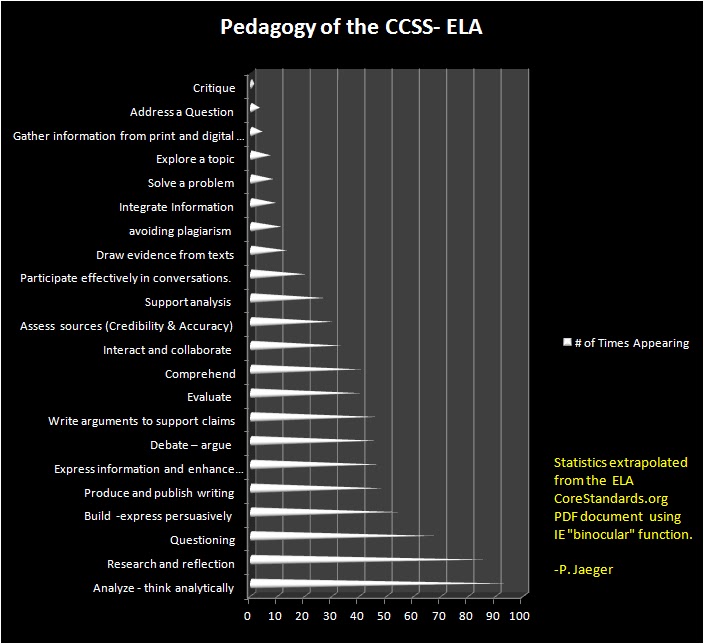
After close examination of the Common Core Standards for ELA, I cannot help but notice that research plays a quantifiable role in how the crafters expected teachers to deliver their content.  We educators hear a tremendous amount about "drawing evidence from the text" and "close reading,"  but why are we not hearing as much about "research both short and sustained projects?"   Why are we not ringing the "conduct short and sustained research projects" ourselves?  

Perhaps teachers are so busy examining the trees that they haven't viewed the forest.  The big picture says: "Insure you have packaged your content in a captivating, 21st Century technology-infused, information integrated, essential question-driven, CCSS package.  

Visit your librarian today and plan a unit for tomorrow.  What question can you ask, that compels students to:
    • examine
    • ask questions
    • research
    • read
    • conclude
    • cite evidence
    • solve a problem, and
    • present their knowledge  


These statistics were quantified using the IE "binocular search" tool with the ELA standards.  
Import the statistics into Excel and graph. 
 [http://www.corestandards.org/assets/CCSSI_ELA%20Standards.pdf]
For those unfamiliar with this tool, here's a snippet:


Thursday, March 1, 2012

Why "relevant" and "meaningful" works in education

There is a simple profound, old quote which is sometimes attributed to Mother Teresa :  "It is better to do great things, than to be great."   

Alan November touts this model for classroom instruction in his TED talk.  This is a must see for teachers who believe that students need to uncover and discover, rather than listening to teachers merely "cover."    In this fifteen minute video about teaching with meaning, Alan shares a few examples of how students are changing the world for no monetary gain--but merely to leave a legacy.

November didn't tout the CCSS and cross-walk standards, but presented a challenge of packaging our curriculum delivery through real world models. 

The CCSS want students to "solve  problems."  Remember, we are not preparing students for exams.  We are preparing students for real world readiness.   See your librarian to design a unit of discovery.  Your information center can help students research, synthesize meaning, and create a knowledge product which entails being an agent of change.   Kids watch a ton of reality shows, why not fashion your classroom that way?  


Sunday, January 29, 2012

Information Architecture--express yourself!

A new term has arisen for Infographics-- Information Architecture--data visualized.   To capture and summarize the meaning of a bundle of information in visual form is truly an artform requiring higher level thought.  This helps our heavily visual generation understand and remember details of data more readily.   

Infographics have been around since sliced bread, but was brought into the spotlight during the summer of  2010  when the New York Times journalists ran a summer blog for their education following.   Infographics actually is  a higher order thinking activity that translates deep meaning of information into a picture representation.  Be sure to check out those NY Times resources above.  They are wonderful.

Data Visualization, information digestion, information architecture... either way, I like it. Students like it.  Why not turn your assignment knowledge product into an Infographic challenge?  
  • Create an infographic depicting the impact of a man-made disaster.
  • Create an infographic on the Civil War.
  • Create an infographic on the benefits of solar power. 
  • Extrapolate data from the NFL website and depict five ratios you found. 
  • Convince me, via an Infographic, to watch what I eat .
  • Defend your position on ___________ via an Infographic. 
 If you look at the Common Core verbs below, you can spot many instructional verbs from the CCSS which would be embraced by research project ending in an infographic:
Integrate
Evaluate
Comprehend
Critique
Analyze - think analytically
Address a Question
Solve a problem
Conduct a short research projects
Conduct sustained research projects
Students generate questions
Explore a topic
Draw evidence from texts
Support analysis
Research and reflection
Gather information from print and digital sources
Assess the credibility and accuracy of sources
Integrate information avoiding plagiarism
Produce and publish writing
Interact and collaborate
Debate
Write arguments to support claims
Formulate an argument
Comprehend
Prepare and participate effectively in conversations.
Build and express persuasively
Express information and enhance
understanding
For the ipad, there's a free APP in the app store called 'Infographics' by Column Five and is keyword searchable.  A company that makes infographics professionally, places them out there for use.  Wonderful.  We like free. 
Or,  use their Visualized Data at their website; columnfivemedia.com 
Displayed on smartboard, students can picture what their knowledge products should look like.